Work
Nine of Swords
Sleeplessness. Fear. The weight inside the room.
The Music
Every chapter, in order.
 A Debt Owed Paid in Full
Crossroads Oath stands at the entrance to the musical journey. Before the Tarot, before the attempt to carry a crown, there is a promise made when continuing unchanged is no longer possible. The song's place in A Debt Owed Paid in Full gives that promise its foundation: what happened will be turned into something, rather than left to remain the only language the self can speak.
The Crossroads is not an innocent choice between a clean past and a clean future. The darker self is present, and the weight of the decision does not end when the words are spoken. This opening asks the listener to remain with that charged threshold. It is the released song, distinct from the later short spoken Oath recording in which the Devil names the price. The two belong to the same mythology without becoming the same recording or the same moment of listening.
A structure enters the story before it has become somewhere safe. The Temple Keeps the Sound places the building close to the beginning, where what is carried from the Crossroads has only started to find walls around it. To keep a sound is not necessarily to release it. A chamber can preserve testimony while the person who brought it inside remains enclosed with the echo.
The title's weight deepens across LOSTAT66's wider architecture. The Temple must eventually be capable of holding what people cannot say, without keeping them trapped inside what has been said. Here that purpose is still unfinished. This is not the later title track The Temple, and its position does not claim the shelter has already been built. It is an early stone in the same difficult question: can something made from pain become more than a place where pain repeats itself?
The title leaves ritual standing after other things have fallen away. The Ritual Is All That's Left can be entered through LOSTAT66's recurring tension between a promise and the repetition meant to sustain it. An action may continue when its meaning feels distant. An obligation may keep its shape while the person who first accepted it struggles to locate himself within that shape.
At this early point in the story, the track sits close to the Crossroads Oath, before the Tarot will expose consuming promises and inward punishment in greater detail. Its title holds an uneasy remainder rather than a completed answer. What remains standing is not automatically what remains alive. Within the larger descent, that question will return to the altar, the tools and the walls themselves. The ritual belongs to the foundation, but the human purpose of keeping it cannot simply be assumed to have survived unchanged.
Thirty-Third Degree closes the opening EP within the language of initiation. The title belongs to a project where degrees, oaths, tools and unfinished stone form a personal symbolic architecture. It draws towards the person standing at the threshold, still carrying what the road could not settle. The number 66 remains LOSTAT66's own cipher, not a historical fact.
At the end of A Debt Owed Paid in Full, that language keeps the listener at a threshold rather than offering a certificate that transformation is complete. A promise has begun something. It has not made the person who swore it finished, or placed the future beyond consequence. The next chamber, Do Not Resuscitate, asks what cannot be carried forward. This closing title leaves initiation with its proper weight inside the story: the beginning of work that must still be lived, not a height from which the narrator can stop becoming or look down on anyone else.
 Do Not Resuscitate
Dead Weight names the feeling of carrying a life that no longer seems to reach the person carrying it. The returning lyric keeps the burden ordinary and close: cold coffee, unfinished responsibilities, contact unanswered, a name that sounds as though it belongs to someone else. The body continues its hours while meaning appears to land nowhere.
Placed at the entrance to Do Not Resuscitate, the title is not accepted as a true measure of the narrator's worth. It is the language of a state that has become difficult to describe from inside. That distinction matters to the wider Temple, where weight must be held without the person becoming identical to it. The song's position lets the consequence of the Oath be felt before it can be resolved. What needs to end is the pattern's claim over the whole life, not the life that has struggled beneath that claim.
The original Nothing Left to Bury lyric refuses a dramatic ending that would make the damage easy to identify. Choices stop registering. Days become grey static. Conversation is borrowed language, answered from habit while the truth feels large enough to empty the room. The fear is gradual disappearance rather than one final event.
Addiction and depression narrow the narrator's sense of what could still be saved, but the song does not need that narrowed view to become the final truth of his life. Within Do Not Resuscitate, it is testimony from a severe absence. Even chaos begins to look preferable to nothing because it once felt like evidence that someone was there. This is the earlier song, not The Devil's later Nothing Left to Bury II. Its place near the Crossroads keeps the listener close to the cost of continuing by habit when the habit no longer feels connected to wanting to live.
The title directs attention away from appearance. Rotting from the Inside belongs to a chamber where the outside can continue to look occupied while the person within feels increasingly remote. It gives deterioration an inward location, keeping the listener from relying on a visible collapse as the only sign that something has become unbearable.
Within Do Not Resuscitate's established meaning, this inward damage is part of why familiar patterns cannot simply be restored each time they begin to fail. What has been called survival may be preserving the outline while narrowing the life it was meant to protect. The song's title holds that contradiction without requiring an invented incident or a literal description of the body. Its place in the opening descent asks what is being kept going, and for whose sake. A structure can remain upright long enough to hide how little room remains for the living person inside it.
Already Gone closes the EP with the severe distance between outward continuation and inward presence. The returning lyric lets a pulse register while the narrator feels absent from it, answers conversations through habit and moves through familiar rooms as though the life inside them has become someone else's. The phrase belongs to that exhausted perspective, not to a declaration that there is truly no person left to reach.
At the end of Do Not Resuscitate, the title carries the chapter's consequence towards the next doorway. Old patterns have made continuing feel like leftover motion. The wider journey cannot rebuild honestly by calling that motion enough, or by pretending the absence is peace. Three Inverted Nines will turn the path towards the Tarot and the mind under siege. This ending leaves the weight unresolved while refusing to mistake an unresolved state for the end of everything the person might still become.
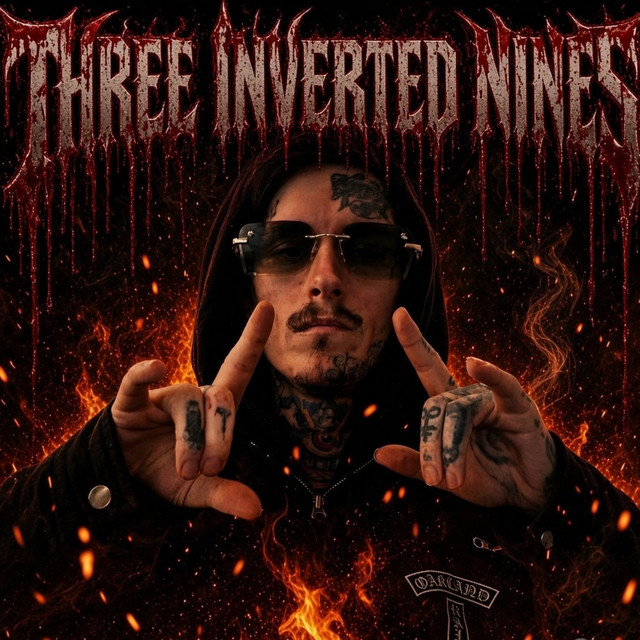 Three Inverted Nines
A word can be sought as though finding it would restore the whole structure around it. Lost Word opens this doorway album within LOSTAT66's established language of silence, naming and the things that remain difficult to say. The title carries absence rather than a solution. Something central is missing, and the act of searching already shapes the person who wants to speak it.
At this point in the journey, the Crossroads promise has begun to gather an architecture. Language matters because the weight needs somewhere to become testimony. But the story repeatedly questions whether the right words alone can make the person whole. Lost Word holds that question at the entrance to twenty tracks of symbols and recurrence. The listener is not given a secret phrase to repeat. The absence is allowed to remain meaningful while the path turns towards the inward rooms where silence will become pressure of its own.
The stone is expected to become perfect, and every blow appears to make it more broken. Rough Ashlar turns the builder's image into a voice of rejected selfhood: tools rust at the narrator's feet, the plan offers no answer, and other stones seem able to rise into an order he cannot enter. The pain is not only being unfinished. It is believing unfinished means unfit to belong.
That distinction echoes through the wider Temple. This lyric speaks from within the rejection, not from the final authority of a structure deciding who deserves a place. The hands keep trying to cut away the failed parts until shaping begins to resemble punishment. As an early track in Three Inverted Nines, the song exposes how an ideal of improvement can become another enclosure. The roughness remains, but so does the person, whose worth cannot honestly be measured by the surface the gavel failed to produce.
Veil Remains places something between the person and a clear view. In LOSTAT66's public symbolism, awareness is never simply decorative; seeing the self can require surrendering the excuses and protections that made not seeing bearable. This title holds the opposite pressure: the covering persists, and the listener remains at a distance from what might be behind it.
In the corridor between the opening story and the Tarot, that remaining veil matters more than a promised revelation. The album has not certified that entering its symbolic language makes everything understood. Words, marks and structures can become familiar while the person using them remains hidden from himself. The title keeps that incompleteness in view, leaving concealment as something felt rather than a distance safely explained. The Temple remains under construction, and seeing it from the threshold is not yet the same as knowing whether its walls are protecting life or keeping life outside.
The title leaves raising as an unfulfilled expectation. Raising Never Found belongs to a journey where the promise of becoming cannot be treated as proof that becoming has happened. Something is sought in the movement upwards, but the certainty imagined at its end remains absent. An entrance has been crossed without guaranteeing an answer on the other side.
A threshold can be crossed while the person crossing remains painfully unsure what within him has begun to change. Within Three Inverted Nines, the unresolved expectation helps prepare Nine of Swords, where the language of resurrection and identity will become strained by exhaustion. The larger story keeps asking what can be built from what remains. Here the title lets the wish for an assured transformation stand without fulfilling it on the narrator's behalf. The person is left with the work, not a declaration that the work has already made him complete.
A light named inside this dark architecture must be approached without assuming what it promises. Blazing Star brings a luminous title into Three Inverted Nines, where symbols are gathering but their human meaning cannot be taken for granted. In LOSTAT66, a mark is important because of its relation to the journey, not because its brightness automatically makes it a guide.
The track's place in the doorway album allows that contrast to remain active. The listener can look towards an image of light while still carrying the cost of the Crossroads and the uncertainty of what comes next. Light has weight in a world where the person is still learning the difference between being shown a direction and being able to move. Its question belongs to the same unfinished Temple: what does someone follow, and what remains their responsibility even when there is something bright enough to look towards?
The floor is where the person has to stand, however elaborate the structure above it becomes. Checkered Floor can be approached through LOSTAT66's language of geometry, repetition and the distance between one state and another. The title offers a patterned ground, but a pattern alone cannot decide what a human life should become upon it.
Within Three Inverted Nines, this is one of the ways the architecture takes shape before the Tarot turns it inward. The listener is brought close to the surface that carries the steps, not only to the destination imagined ahead. Repetition can look like order while the person repeating remains divided. The track's title holds that difference without making a historical lesson from the image. This floor belongs to the project's own symbolic world. It is ground for a passage still being walked, not evidence that the traveller has already reached an integrated or finished self.
A direction has failed to deliver what its promise suggested. East Never Brought the Day holds the distance between looking for light and feeling it arrive. The absence is close enough to be felt without becoming a place that can be left behind on a map. Its pressure belongs to an expectation left standing after the anticipated change has not come.
In LOSTAT66's established architecture, initiation and awareness cannot be reduced to occupying the right position. A person may face towards something called an answer and still remain in darkness. As part of Three Inverted Nines, this title contributes to the doorway's unease: symbols have begun to organise the journey without ensuring that the person feels held by them. The Tarot ahead will expose that tension more intimately. For now, the promised day remains outside reach, and the listener is asked to notice the weight of the word never without turning that despair into the whole horizon of the story.
A bond can be felt before it is understood. Cable Tow brings another title of attachment into an album concerned with oaths, thresholds and the changing meanings of what holds a person. LOSTAT66 repeatedly asks whether a structure supports the self or prevents it from moving. That tension runs beneath the promise, tugging at the difference between being held and being unable to leave.
Here, commitment has weight, and the thing experienced as connection can also become a chain. The Crossroads has already made a promise central to the journey. Three Inverted Nines explores the symbolic corridor that promise opens. A tether in such a world cannot automatically be called rescue or captivity. The distinction depends on what it allows the person to become. The title keeps the listener near that unresolved pull while the path moves towards the inward confinement of the first Tarot chamber.
Three Lesser Lights holds illumination in a title that refuses to make it absolute. Within LOSTAT66's symbolic world, seeing is a difficult act rather than an entitlement conferred by a room. Light may make an outline visible without revealing everything that outline contains. The unfinished self does not become finished merely because more of it can be seen.
Placed within Three Inverted Nines, this title belongs to the gathering language of geometry, recurrence and initiation that prepares the Tarot. Its lights belong to this personal mythology, where a symbol keeps its weight through the life that moves beneath it. The listener is kept close to partial knowledge: enough to notice a wall, perhaps not yet enough to know what has been sealed behind it. The larger Temple will need awareness as well as structure. This title allows awareness to begin without claiming it has already become a complete account of the person.
The lyric begins with closeness arranged as a promise that nobody should walk alone. Five Points of Fellowship then turns that promised contact into the felt absence of support. The narrator reaches towards a bond that no longer seems to hold, keeping its old positions while finding empty air where another person should be.
Its grief belongs to a human need for belonging, expressed through the project's ritual imagery rather than offered as evidence of a real-world institution. The title's geometry cannot guarantee care. In Three Inverted Nines, that failure exposes another gap between form and life: a promise of fellowship can remain speakable after the person inside it feels released from every hand. The song does not prove that the narrator deserves abandonment. It records the pain of believing the promise should have held, and the difficulty of remaining upright when its language is still remembered more clearly than its warmth.
Sprig of Acacia introduces a small, living title into an architecture dense with stone, tools and obligation. Its meaning here is approached within LOSTAT66's public vocabulary of memory, survival and what can remain without claiming an external historical explanation for the symbol. The scale is enough to make the contrast meaningful: not another wall, but something that can be held against the weight of the building.
In the threshold album, the title can keep attention on the difference between preserving a trace and imprisoning a life inside its history. The wider journey will return to graves, former selves and the possibility of remembering without returning. The image can remain beside those questions, small enough to carry while the larger structure still asks how memory should be held. Something can remain significant without being required to keep the person carrying it forever at the point where the significance began.
A patterned surface can appear to contain an order the person walking across it cannot yet inhabit. Master's Carpet belongs here to the builder's symbolic language, where plans, measurements and repeated forms do not automatically make a life whole. The title draws attention towards a ground arranged with meaning while leaving open how that meaning is experienced from within.
The patterned ground belongs to a personal mythology, its order still unable to settle every question brought across it. Three Inverted Nines is preparing the inward turn, collecting structures that will later become body, judgment and confinement in Nine of Swords. The important distinction is between an ordered image and an ordered self. A person can know the pattern and still feel lost upon it. The Temple remains unfinished because symbols cannot complete the human work on their own, however carefully the marks have been set before the traveller's feet.
Possession enters a story already concerned with what belongs to a person and what begins to act as though it owns him. The tension remains close to the self, where familiarity can make a claim feel older than the moment it is recognised. A memory, a pattern or an identity can become so familiar that carrying it starts to feel indistinguishable from being carried by it.
Its place in Three Inverted Nines keeps this question before the Tarot confronts bondage more directly in The Devil. This is not the later Possession Complete, and the title does not justify pretending the two recordings are the same song. It belongs to the doorway's developing vocabulary. The person has promised to transform what happened, yet transformation still has to be separated from continued captivity. To call something one's own is not necessarily to stand free of it, and recognising that ambiguity is part of entering the next chamber honestly.
A candidate stands before something not yet entered, carrying an expectation of becoming. Hollow Candidate places absence inside that expectation. The title belongs to LOSTAT66's threshold language without requiring a literal initiation story: someone can occupy the correct outline while feeling increasingly distant from the self the outline is meant to contain.
Within Three Inverted Nines, that distance prepares the first Tarot card's questions of identity. The journey does not make a person whole simply by naming the next stage. There may be an entrance, a role and a promise while the person remains unsure what within him is being offered to them. The title's hollowness is therefore held as a perspective, not a verdict of worthlessness. The larger Temple exists for people whose absence has become difficult to say. This chamber lets the emptiness be acknowledged before the story can ask what kind of becoming would actually make room for life.
An established direction is turned in Inverted Degree. The title belongs closely to this album's explicit concerns with inversion, repetition, cycles and transformation, where progress cannot be assumed from the appearance of movement. A stage can be entered without bringing the traveller closer to an honest relationship with himself. Something can change its position while leaving the old weight in command.
This turning belongs to LOSTAT66's own mythology, where a mark must keep answering to the person who gives it meaning. What matters is the act of turning and the uncertainty it reveals. The Crossroads promise has opened a journey that cannot guarantee an unchanged person at its end. Here the title makes direction itself questionable. The listener is being prepared for a cycle that must be lived from within, where the difference between transformation and another repetition will have to be recognised rather than granted by a symbol alone.
To be held can mean being supported. It can also mean being unable to leave. The Grip can be approached through that unresolved distinction, already present in LOSTAT66's oaths, chains and need for belonging. The title does not tell the listener in advance which kind of holding has been found, and the surrounding journey gives reason not to assume they are always easy to separate.
After the promised contact of Five Points of Fellowship, the idea of a grip remains charged with both need and doubt. The need for support remains human, even when the symbols around it have grown difficult to trust or to put down. Within Three Inverted Nines, it keeps the human stakes beneath the ritual vocabulary visible. A hand can be remembered as safety even when its absence or pressure changes what safety means. The Temple will need to hold weight without taking possession of the person who puts it down.
A named place of belonging enters the corridor in The Lodge. Within LOSTAT66's personal mythology, such a place can be read through the tension between structure and the life inside it. Walls may offer order, fellowship and a language of purpose while still failing to make someone feel at home. Entering a room and finding a place are not always the same act.
This title is not treated as proof of actual membership or ritual practice. It belongs to the album's established architecture, which prepares the Tarot's inward use of similar images. Nine of Swords will bring the lodge towards confinement and burial; here, the doorway record allows the place-name to carry its uncertainty before that later chamber is reached. The listener is asked to notice the human question beneath the symbol: what kind of structure can contain a person without requiring him to disappear in order to belong?
Something brought to the threshold can be an act of commitment, but what is asked in return cannot simply be assumed harmless. The Offering belongs to LOSTAT66's established altar language: sacrifice, promises and the effort to give suffering a purpose. The altar keeps that question near: what can be given without making another offering of the person who is still trying to live?
Across the larger journey, giving will have to be separated from vanishing. Sacrifice will eventually be asked to mean surrendering what harms the heart, not surrendering the heart itself. This early title does not borrow that later clarity and pretend it is already secure. It keeps the cost near the altar, where the person still has to understand what can be given without losing the possibility of a future. Within Three Inverted Nines, the offering remains part of initiation's weight, not a guarantee that enough has now been paid to make a life whole.
The name appears inside the doorway album as a title of its own. Lost At 66 can be entered through the public lore: the wound, the threshold and the project's private cipher of initiation, doubling and transformation. The number is not a historical answer waiting to be supplied. It is part of the language through which this world asks the person to face himself.
Here, before the Tarot cycle, the name carries an unresolved location. The traveller has entered the symbolic architecture without necessarily knowing what it will make visible. That position differs from Lost at Sixty-Six on The World, where self-recognition gathers the cards already faced. The recordings must not be treated as interchangeable merely because their titles echo. In this earlier place, being lost remains a threshold rather than a conclusion. The listener stands before a longer descent, not beyond a finished interpretation of what the name can hold.
A shrine can preserve the thing it is built around so completely that preservation becomes captivity. Malevolent Shrine closes Three Inverted Nines within LOSTAT66's established warning against worshipping pain. The image keeps that warning dark, close to the fear that what has been preserved can learn to demand more than remembrance. What has been honoured may also have been allowed to govern too much of the life.
At the end of the doorway album, this image prepares Nine of Swords' inward enclosure. The listener is about to enter a chamber where the building will feel like skin and the promise will risk consuming the person who kept it. The title does not mean the wider Temple is intended as harm. It exposes why the Temple must be built honestly and remain open to change. A structure raised from suffering needs a purpose beyond preserving suffering, or the person seeking shelter can become another offering to the wound.
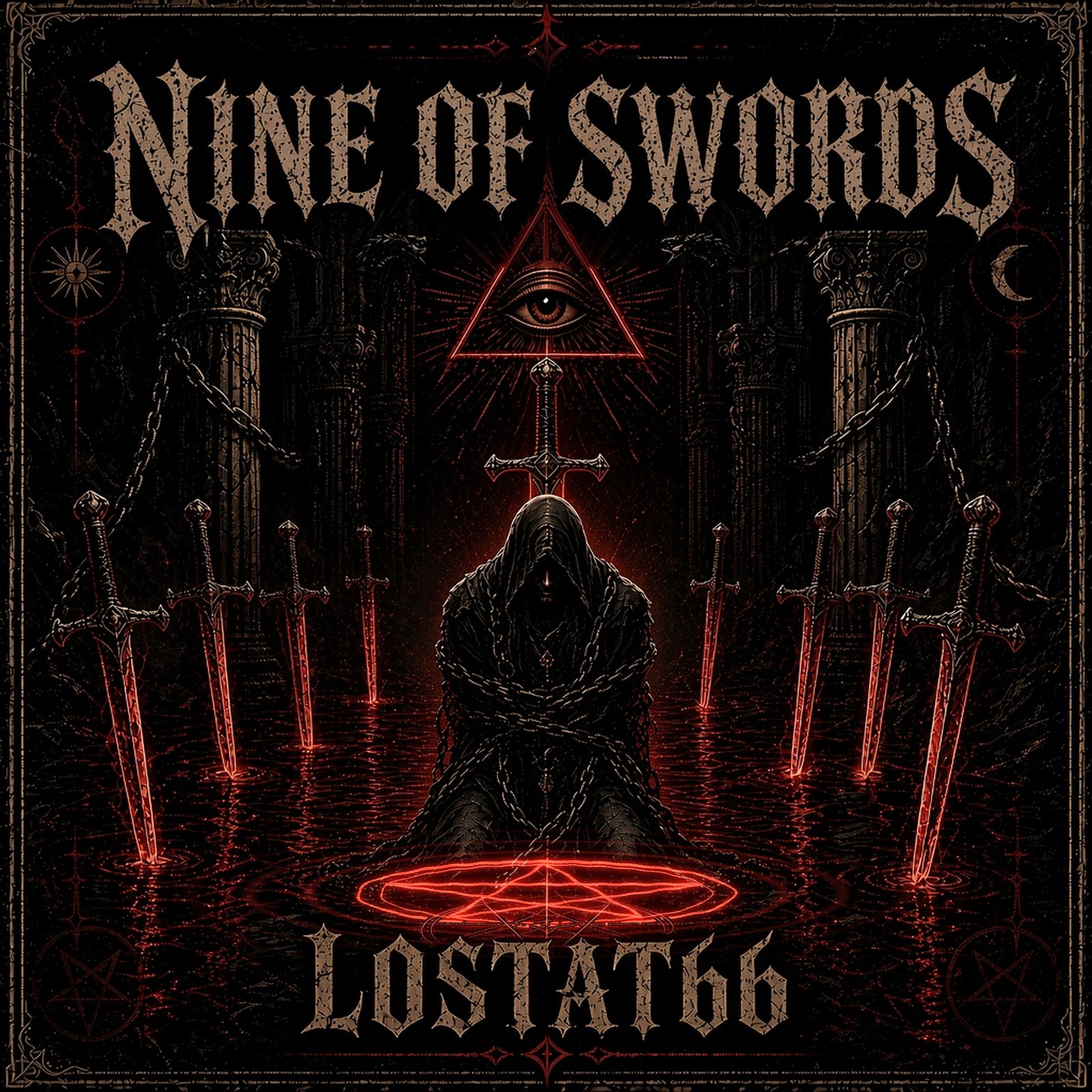 Nine of Swords
A name should make something recognisable. Here, recognition carries dread. Name That Ate God opens Nine of Swords at the point where identity presses against the belief that once supported it, until the thing being named threatens to consume the structure that gave the naming meaning. The title does not need a literal deity or an invented event to make that rupture felt. Its force belongs to a person finding that the old language can no longer contain what he knows of himself.
As the first step inside the Tarot cycle, the song establishes a danger that will keep returning: a symbol can become larger than the life it was meant to explain. The chamber begins with recognition, but recognition does not arrive as relief. Something has acquired a name, and the room can no longer pretend it has not heard it.
Nothing Left to Raise brings resurrection into a room too exhausted to receive it as a promise. What remains is not a triumphant refusal of the past, but grief emptied of the strength to keep asking it to stand. The song belongs to the early inward movement of Nine of Swords, where the language of becoming is still present but the person inside it cannot feel a clear way forward.
Its place after the opening rupture matters. When an identity unsettles the belief that held it, rebuilding cannot simply be commanded into existence. A name is not a foundation by itself. This track lets the absence remain heavy rather than disguising it as certainty. Within the larger journey, it holds the distance between allowing an old self to fall and discovering what, if anything, can be raised from what remains.
The question in Who Am I does not wait politely for an answer. It follows the collapse of familiar belief into the roles that once made a person understandable: the names tried on, the positions occupied, the versions offered to the world. None can settle the disorientation. A role may fit the outline and still fail to reach the person standing inside it.
In Nine of Swords, identity is not an object waiting intact beneath the wreckage. It is part of what has become uncertain. This song gives that uncertainty its own chamber without solving it through another mask. The wider LOSTAT66 story keeps asking what survives when the old means of survival no longer define a life. Here the question is still raw. Before the person can choose who comes next, he has to remain with the fact that he does not yet know who is speaking.
Silence is not peace in this room. It is what remains when speech and ritual language can no longer do the work expected of them. Silence holds that failure without filling it with a substitute explanation. Words may still be remembered, but remembering the words is not the same as feeling their meaning. The absence gathers pressure precisely because it cannot be made useful by reciting something familiar.
Placed inside the mind under siege, the song reverses the ordinary wish for quiet. Quiet does not necessarily free someone from what hurts. It can leave them alone with it, without the distraction of an answer. The track gives one of LOSTAT66's central tensions a close, human scale: the things left unsaid do not become weightless. Sometimes they become the room itself, and the work begins with admitting how much that room can hold.
In I Wear the Temple, architecture becomes bodily. The structure is no longer somewhere ahead, or somewhere a person can decide to visit and leave. It is carried against the skin, becoming both a mark of endurance and a form of enclosure. Suffering can be worn as proof of what has been survived while still keeping the person who wears it inside the same old walls.
That contradiction gives the track its place in Nine of Swords. The building and its occupant have drawn so close that pride in standing can become inseparable from the difficulty of living freely. The song does not declare the Temple complete. It reveals how much of the self has already been made from damage. Later chapters will ask what can be rebuilt differently. Here, the listener feels the weight of a structure that cannot simply be taken off at the door.
The watcher moves inside. The Eye Is Mine turns external judgment into internal surveillance, until the person being observed can no longer keep a safe distance from the one doing the observing. Awareness is one of LOSTAT66's central symbols, but awareness here is uncomfortable rather than automatically liberating. Seeing clearly can expose the habits of punishment that have been mistaken for honesty.
Within Nine of Swords, this is another wall brought close enough to become part of the body. The eye does not need to belong to a mysterious authority beyond the chamber. The narrator carries the gaze himself. That makes escape a more difficult word. The song holds the distinction the wider journey will have to learn: knowing where the damage lives does not require watching oneself forever as though another failure were the only thing worth seeing.
No More West stands where running away has stopped working. Its defiance is exhausted, without the clean distance that would turn remaining present into an easy victory. The song belongs to the moment when another departure cannot promise another self. Whatever direction is chosen, the unresolved weight still arrives with the person carrying it.
Inside Nine of Swords, that recognition does not open the chamber at once. It removes one of its familiar evasions. The road cannot keep doing the work that must happen within. The track holds its ground in that difficult interval: no longer trusting flight, not yet able to call stillness peace. Within the wider descent, it prepares the confrontation with The Devil by letting the old escape lose its authority. If the pattern cannot be outrun, it has to be faced without another horizon standing in for an answer.
The verdict turns inward in Gavel Fell on Me. Judgment becomes something delivered within the person who fears it, and guilt begins to sound less like a feeling than a sentence already passed. The ritual image carries psychological force: a final decision, a command to accept what has been declared, an authority that leaves little room for the complexity of being human.
Nine of Swords lives inside that pressure. This track gives it the shape of punishment rather than treating remorse as proof that punishment should continue without end. In the larger story, responsibility will eventually have to be separated from self-condemnation. Here the two remain close enough to wound each other. The gavel does not resolve the truth of a life. It shows how the mind can turn an unresolved past into a court that never stops sitting, even when nobody else is in the room.
Temple Breathes gives anxiety the unsettling intimacy of a living room that will not release its occupant. Architecture becomes presence. The chamber does not remain an inert container for fear; it seems to share the person's breath, carrying the pressure into the very space that should offer somewhere to rest. There is no clean outside position from which to observe what is happening.
Coming after the inward verdict of Gavel Fell on Me, the track makes the enclosure feel increasingly inseparable from the person enclosed. It belongs to the album's movement from symbol towards body, from something understood at a distance to something lived. The wider Temple must become a place capable of holding weight without becoming a prison. This song stays with the earlier, darker possibility: a building can seem alive while the life inside it feels less and less able to move.
Promised light does not arrive in Hoodwink. The blindfold carries more than the threat of being deceived by something outside. The song also confronts the difficult awareness of one's own participation: the hope that kept the cloth in place, the willingness to believe that enduring the darkness would guarantee an answer. Humiliation enters where that expectation breaks.
Within Nine of Swords, this is not a lesson in a literal ritual. It is a room of disappointed belief. The person who wanted revelation has to face the possibility that wanting helped conceal what needed to be seen. That does not make the hurt unreal or turn the whole burden into blame. It makes the act of looking more complicated. The track keeps the promised threshold in view while refusing to invent a light beyond it merely because the person waiting has already paid so much.
The lyric makes a promise bodily: each vow becomes a mouth, each seal a tooth. Obligation Ate Me follows commitment until the distinction between keeping a promise and being consumed by it begins to disappear. The narrator still has the language, the posture, the repetitions. What has diminished is the person who first meant them. A boundary imagined as protection has learned to feed.
Its horror belongs to the wider Oath without explaining that Oath away. Loyalty and resentment remain bound together. The track asks what happens when a fearful promise continues to demand obedience after its human purpose has been lost. In Nine of Swords, that demand becomes another form of internal siege. The words remain intact while the speaker struggles to locate himself inside them. What survives the recitation is not automatically the thing the recitation was supposed to protect.
Instruments of balance and discipline become instruments of self-punishment in Working Tools. The difference is not necessarily visible in the object. It lies in the hand using it, the standard imposed, the refusal to accept that becoming human is not the same as being cut into an immaculate shape. The song keeps the established builder's language while exposing how its purpose can be turned inward against the builder.
Placed late in Nine of Swords, the track gathers the album's pressure around a difficult question: can the means of reconstruction become another way to continue the damage? The wider journey will return to discipline in The Emperor, but it cannot honestly do so without passing through this room. Here, measurement does not yet mean understanding. The work has become a demand, and the person beneath it has not found a way to put the tools down.
The closing image brings initiation and burial to the same threshold. The Lodge Is The Coffin does not turn surrender into peace. It leaves the listener inside the possibility that what promised to remake a person has become the structure in which the person disappears. The language of entering and the language of ending can no longer be kept comfortably apart.
As the final track of Nine of Swords, it closes the first Tarot chamber without offering a finished escape from it. The mind under siege has revealed how belief, judgment, obligation and self-punishment can become an interior architecture. What comes next is The Devil: a deeper confrontation with the things controlling that interior life. The coffin is not the conclusion of LOSTAT66. It is the severity of this chapter's enclosure, and the reason the journey cannot pretend that simply surviving the room has made the next choice easy.
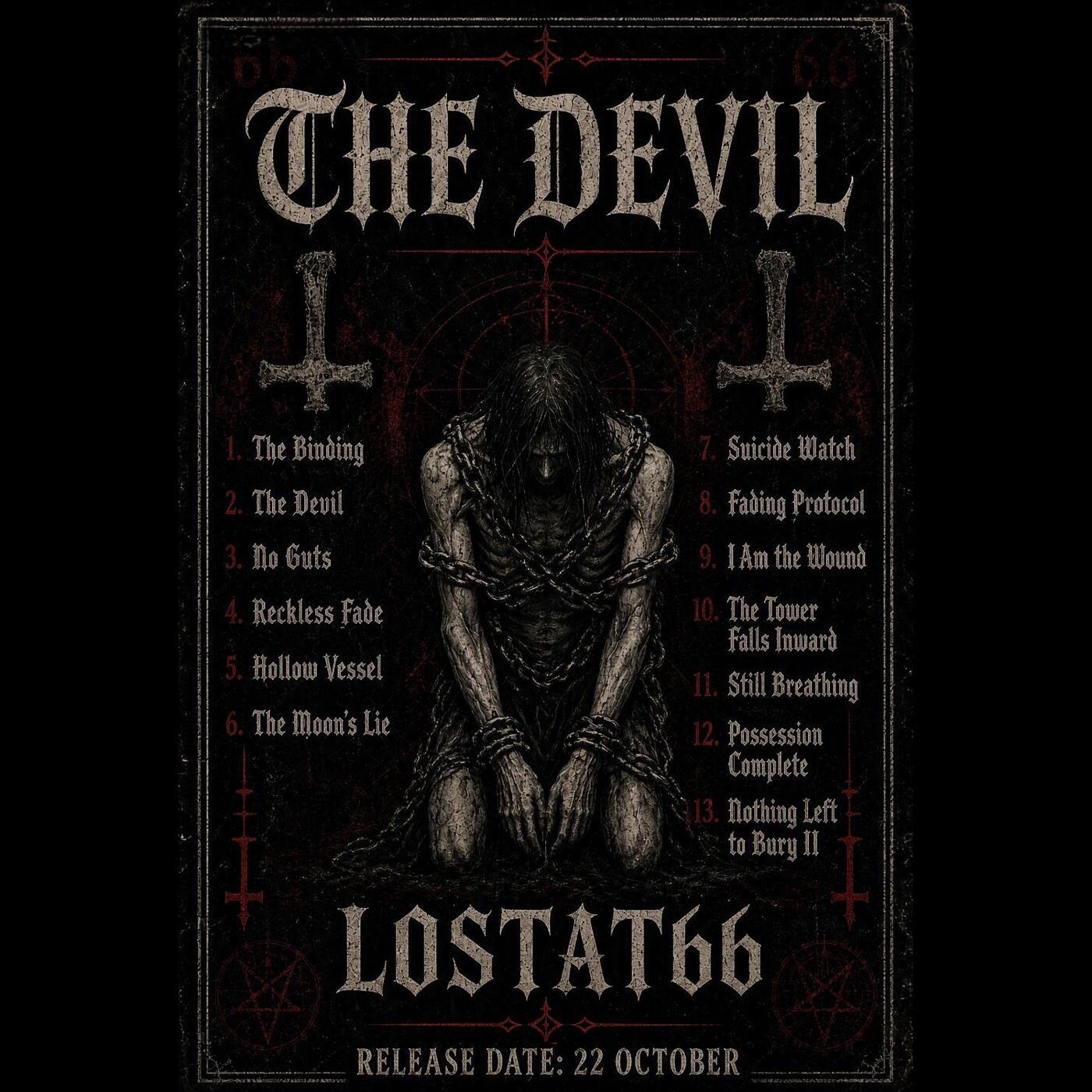 The Devil
The Binding begins before the price of relief is fully understood. Comfort becomes a lock by degrees, close enough to something needed that its narrowing edges are difficult to recognise. The song opens The Devil not with a stranger arriving from nowhere, but with a change in the meaning of something already allowed near. What once seemed to loosen the weight begins to decide how the weight will be carried.
This is the second Tarot chamber's first movement: bondage entering daily life. The Crossroads figure has not vanished just because the journey has moved beyond the road. His familiarity is part of the danger. The track keeps the moment of binding intimate, refusing to confuse the feeling of being briefly held with the freedom to move. The lock has a history, and that history begins before it is named.
Naming the presence does not drive it out. In The Devil, the pattern speaks through the narrator, closing the distance between the person and the thing understood to be controlling him. The figure is no longer safely placed beyond the threshold as an enemy who can be pointed towards. Recognition turns the voice inward. What has been repeated has learned how to sound like the self.
The title track deepens the Crossroads encounter rather than retelling it. This is not the moment of making the Oath. It is the life in which the darker self must be understood after the promise has already been made. Within the album, the song establishes the difficulty that every later track inherits: knowledge can expose the chain without loosening it. The name is spoken. The presence remains, and the chamber has not opened merely because it has been described.
No Guts turns contempt inward. Its pressure comes from hesitation meeting a voice that treats hesitation as another reason to despise the person experiencing it. The song belongs to The Devil's account of control: not only what a pattern makes someone do, but how it teaches them to speak to themselves while they are caught inside it.
The cruelty of that voice is not a measure of the narrator's worth. Nor does the track turn the edge of despair into a heroic act. It stays with the shame and paralysis that can make every possible movement seem like evidence against the self. In the wider story, this is one of the ways the chain becomes difficult to see. Punishment sounds like honesty. The person is left arguing with a verdict that has already decided how to hear the answer.
The disappearance in Reckless Fade is cumulative. Repeated impulsive choices wear away the life around them without requiring one spectacular moment to explain the damage. The title holds that movement between recklessness and fading: actions can be forceful while the person acting becomes less and less able to recognise where they have arrived.
Within The Devil, the song refuses the simplicity of a single fall that could be isolated, named and left behind. Its erosion belongs to the pattern, to the recurrence that makes the next choice feel familiar even as the consequences gather. That is what gives it a place in the continuous descent. The chamber is not built in one night. It grows through what is repeated. The track lets the listener remain with that uncomfortable scale, where small acts can carry a weight their moment does not reveal.
The body remains in view while personality empties in Hollow Vessel. Dependency has not removed the outward shape, which is part of what makes the absence difficult to explain. A person can still occupy the room and still become increasingly distant from the life that room appears to contain. Presence and participation have ceased to mean the same thing.
This track gives The Devil's bondage a particular form: not an added monster, but a diminishing self. The vessel is there. What it carries has been altered by the pattern filling it. Within LOSTAT66's wider language of chambers and bodies, the image draws towards the fear that survival can continue after feeling has withdrawn. It is not a declaration that the person is truly empty. It is testimony from inside an emptiness that has begun to sound like an identity.
Night becomes an unreliable storyteller in The Moon's Lie. The lyric watches familiar rooms shift and trusted faces become difficult to read, while the darkness rewrites failure into something unbearable. The chorus gives that voice its name. It tells the narrator he is finished, tells him to run, and returns close enough to belief that knowing it is false does not settle the argument.
The song's force lies in that repeated almost. Resistance exists, but it has not silenced the story the night keeps telling. Within The Devil, this becomes a portrait of distorted certainty and obsession rather than a supernatural explanation for suffering. The track can recognise the trick and still feel its pull. Its later acoustic reflection in Welcome to Anhedonia returns to the same unstable room, where quieter surroundings do not automatically make the voice less convincing.
Suicide Watch occupies the tension between exposure and secrecy, between being watched and being able to reveal what is happening inside. Vigilance does not automatically dissolve isolation. The song gives the danger its seriousness without making it a spectacle or reducing the person at risk to the risk itself. Its weight belongs to the difficulty of remaining visible when shame keeps asking for concealment.
Within The Devil, that tension follows the chapter's deeper concern with control. A person can be physically present and still struggle to make their internal state known. Being seen from outside is not always the same as being understood. The track holds that distinction without claiming a diagnosis or supplying an invented personal event. It remains part of the descent's human testimony: the need for safety can exist alongside the fear of letting another person know how much safety is needed.
In Fading Protocol, disappearance becomes routine. Shame organises the ordinary movements until connection and presence begin to feel mechanically erased. The title's coldness matters within the album: what hurts has ceased to look like an interruption. It has acquired a procedure, a way of repeating itself that can make the loss difficult to recognise while it is happening.
The track belongs beside Reckless Fade without simply repeating it. One exposes the wear of impulsive choices; this one follows the pattern as it becomes an everyday arrangement. In both, the person is diminished by recurrence rather than removed in a single scene. The wider Temple is built from decisions too, but this chamber shows the darker construction: repetition can make a prison feel ordinary. The song gives that ordinary damage a name before the story can begin to ask what might be done differently.
The title leaves almost no distance between injury and identity. I Am the Wound stands at the point where having been hurt threatens to become the only available account of being a person. The wound is not merely remembered. It occupies the name, narrowing the self until every other part becomes harder to see through it.
Within The Devil, this is one of bondage's deepest forms. A pattern need not be experienced as something imposed from outside if it has become the way the person understands himself. The song holds that enclosure without asking the listener to accept it as the final truth. The wider journey will make room for the wound without granting it the whole life. Here, the separation has not yet been learned. The statement is severe because the voice can no longer easily imagine saying anything beyond it.
The Tower Falls Inward keeps collapse inside the person rather than arranging it as a public spectacle. Nothing in its meaning requires the world to stop and witness what has fallen. The inward direction is the wound in the title: a structure can give way where nobody else can see the debris, leaving the outward day able to continue.
In The Devil, this follows the shrinking distance between hurt and identity. What seemed to hold the person together can become part of the collapse itself. The track belongs to LOSTAT66's architectural language without announcing a literal ruined building or a completed revelation. Its room is psychological. Its consequence is the difficulty of being understood when the damage does not produce an obvious scene. The listener remains inside that pressure, where falling apart and continuing to appear can occupy the same moment.
Breath continues. Still Breathing refuses to turn that fact into a claim of freedom. The song stays with physical survival while the pattern remains, making room for the difficult difference between being alive and feeling released from what has been controlling the life. Its title can be heard as persistence without being mistaken for a victory already won.
That distinction matters throughout LOSTAT66. Later chapters will let being here carry a different weight, but The Devil has not arrived at that distance yet. In this chamber, continued breath does not end dependency, shame or the sense of absence. The track protects the honesty of the journey by refusing to borrow hope from a later room and place it where the narrator cannot yet feel it. Survival is present. The work of understanding what survival might become is still ahead of the voice speaking here.
The argument grows quiet in Possession Complete, not because peace has arrived, but because dependency has filled the space where competing voices might once have remained. The chapter's control reaches towards the whole self. The title carries a frightening certainty, yet that certainty belongs to the enclosure the song is describing, not to a final verdict on the person inside it.
Placed near the end of The Devil, the track gathers the binding, the fading and the threatened disappearance of identity into one severe point. Recognition alone has not supplied an exit. A single voice seems to occupy what used to be conflict. The wider story will continue, but this room does not pretend to know that continuation as relief. Its silence is the absence of resistance, and the listener is asked to hear the difference between that absence and being able to rest.
The sequel returns to a title already heavy with disappearance, but Nothing Left to Bury II belongs to The Devil's later recognition of the pattern. The available lyric imagines the body, name, history and occupied spaces falling away, leaving no clean burial through which an ending could be made understandable. Erasure does not deliver the peace its completeness might seem to promise.
As the album's closing track, the song does not grant an escape the chamber has not earned. The pattern still inhabits the narrator. Recognition is present; release is not. That unfinished condition is what passes towards The Lovers, where attachment will confront the same unresolved self in another form. This is not the end of the person, nor a celebration of vanishing. It is the darkness of a chapter that cannot yet imagine leaving a trace without feeling that the trace belongs to its captivity.
 The Lovers
All of Me begins with total surrender offered before trust has become a place capable of holding it. The title sounds complete, but completeness here has no protective edge. Everything is placed within another person's reach while the question of what will meet that offering remains unanswered. Devotion and self-erasure stand dangerously close together.
As the opening of The Lovers, the track carries the preceding chapter's unresolved bondage into intimacy. The need to be chosen has not become harmless merely because it now speaks the language of connection. The song asks what happens when a person gives away the boundary that would let them remain themselves inside a bond. It does not dismiss the feeling as false. It exposes how an honest desire for closeness can carry an old wound through a new doorway, and how much is risked when nothing is kept outside that demand.
Union is a choice in The Lovers, not a fate that makes every consequence inevitable. The title track holds the bond as something made between people, which means its breaking cannot be explained away by a promise that it was always written. What joins can come undone. What is chosen asks something of the people choosing it.
That is why this card belongs after The Devil rather than outside the descent as a romantic pause. Attachment does not remove responsibility or the unresolved self. It makes their presence harder to hide. The song gives the album its central tension: the wish to be bound to someone and the need to remain a person within that binding. There is intimacy here, but no guarantee that intimacy alone will make the structure safe. The choice is meaningful because it is not beyond change, and not beyond consequence.
In The Mask, intimacy is troubled by performance. The face that seemed to promise recognition becomes difficult to distinguish from a costume, and the closeness that should make someone knowable reveals how much can remain concealed. The wound is not only the discovery of a disguise. It is the uncertainty that discovery brings to what has already been believed.
The track sits early in The Lovers, where surrender has been offered and the foundation beneath it begins to feel less certain. Recognition arrives, but not as comfort. A person may be looking directly at someone and still struggle to know which version is present. Within the wider story's language of faces and former selves, the mask becomes relational: not simply the identity someone uses to survive alone, but the performance another person has trusted enough to bring close to their own unguarded life.
The change in Split is abrupt. Someone loved is suddenly recast as an enemy, and the shock lies in how quickly the same person can be given an entirely different place in another person's account. This is not the slow wearing away described later in Erosion. It is the fracture of recognition, the difficulty of standing where affection was and finding the terms have changed.
Within The Lovers, instability becomes immediate, close enough to unsettle what the person thought the bond could hold. The person receiving the new verdict has to contend with its force while still carrying the memory of the earlier warmth. The track belongs to the album's concern with choice and attachment because being renamed by someone else can threaten the self already surrendered to the bond. A relationship can become unrecognisable before the person inside it has understood what has been taken away.
Rejection reaches the room before the explanation in Cold Eyes. Withheld warmth becomes its own message, felt in the space between people who were supposed to be close. The song does not require a speech to make the distance intelligible. Its pressure comes from the absence of what once made the bond feel inhabited, and the uncertainty of waiting for words to confirm what has already been felt.
In The Lovers, that silence differs from the solitary pressure of Nine of Swords. Another person is present, yet closeness does not follow from their presence. The track holds that difficult interval, leaving the silence heavy enough to become a distance of its own. What matters is the experience of warmth withdrawn. Within an album that begins by offering all of the self, such an absence can feel enormous: not because the room has changed its shape, but because the person waiting inside it no longer knows where they are allowed to stand.
Affection arrives intermittently in Drip Feed, enough to keep attachment alive without letting it rest. The almost becomes a form of control. What is wanted remains close enough to wait for, but not stable enough to become a foundation. The song gives the cycle its own shape rather than describing every injury as a single act of rejection.
Within The Lovers, this is where devotion can become organised around the next small return. The person does not need to receive nothing in order to feel depleted. What is received can keep the absence powerful, making the bond difficult to release precisely because it sometimes appears to answer. The track carries The Devil's language of dependency into connection without claiming that every attachment is the same. Here the chain is sustained by uncertainty. Hope remains active, and that activity becomes part of what holds the person in place.
No single day explains the loss in Erosion. The song follows small repetitions wearing down a relationship and the self within it, until the accumulated damage becomes larger than any individual moment can account for. That scale matters. It resists the demand for one scene that would make everything before and after simple.
Placed after the intermittent affection of Drip Feed, the track deepens The Lovers' attention to patterns. A person can keep finding reasons to continue while something essential is gradually worn away. What remains may still resemble the original bond from a distance, even as living inside it becomes increasingly difficult. The song belongs to the wider descent because architecture is not only damaged by collapse. It can be thinned by repetition. Erosion gives that quieter process a chamber, letting its weight be recognised without making one final blow the price of believing the hurt was real.
Memory and responsibility cannot settle into a shared account in The Blame. The verdict keeps moving, leaving the person addressed to answer terms that will not remain still long enough to be understood. The song's tension is not solved by placing all responsibility cleanly on one side. It follows the pressure of an account being contested while attachment is still involved.
Inside The Lovers, that pressure reaches identity. If what happened can always be renamed, the self standing within it can become uncertain too. The struggle remains close to the person inside it, where every remembered word has begun to carry the weight of a verdict. Its place in the story is the experience of being caught within accusation and defence, where the bond no longer supplies common ground. Later responsibility will need an honest measure. Here, the measure itself keeps changing, and every answer risks becoming another part of the argument.
Discard makes rejection physical without giving it the ceremony of a mutual ending. Removal can happen quietly. The bond that once organised a life can cease to make room for the person who remains attached to it, leaving a weight that does not arrive with an explanation proportionate to what has been lost.
The track follows The Lovers' contested account of responsibility into the consequence of exclusion. Quietness does not make the removal weightless, or give the person left behind a language large enough to contain it. What matters is the change in belonging: where the self had been offered, it is no longer held. Within the wider story, this is another reason the Temple cannot ask people to earn their place by disappearing into someone else's terms. Discard stays with the hurt before that possibility is available, allowing rejection to be recognised without pretending it has supplied the person rejected with a finished way forward.
Being assigned the villain's place can offer an ugly substitute for being chosen in Villain. The song follows that contradiction without making it admirable. A hated role may still seem to preserve a bond when the alternative feels like being removed from the story altogether. Recognition becomes distorted by the need to remain somewhere in another person's account.
Within The Lovers, this is not a simple declaration of power over rejection. It is one of attachment's darker compromises. The self may accept a damaging name because the name still connects it to the person whose choice matters too much. The wider LOSTAT66 journey repeatedly asks what happens when a role becomes larger than the life inside it. Here, the role arrives through a fractured bond. The track lets the listener hear its cost without confusing defiance with freedom or the persistence of connection with a place that can safely hold someone.
The self has been spent as currency in Nothing Left of Me. Giving has continued beyond what can be sustained, while attachment remains after depletion. The title holds the fear at the centre of The Lovers: not only losing another person, but becoming unable to find the person who kept offering more in the hope of being met.
Near the end of the album, the track gathers the cost of devotion without boundaries. It does not turn exhaustion into proof that the love was greater or the sacrifice noble. Its severity lies in how little room is left for the narrator within the bond that demanded so much of him. The wider story will have to separate connection from disappearance. Here that distinction is still difficult to feel. The song stays with the remaining attachment rather than calling depletion a clean release or pretending the attachment ends exactly where the ability to keep giving fails.
An ordinary morning can carry more consequence than a final argument. The Aftermath returns the future to the narrator's hands without making him earn that future through hatred. Leaving does not have to mean that every feeling has disappeared. It means there is life beyond the bond, and responsibility for that life is beginning to return.
Within The Lovers, this is a shift in scale after the depletion of Nothing Left of Me. The person is not transformed into someone untouched by the relationship. He is left with the quieter difficulty of what comes next. The track belongs to the wider journey towards boundaries and self-government, but it does not leap ahead into a completed kingdom. It remains with the day itself. There can be a next movement without a triumphant speech, and there can be separation without making hatred the only ground firm enough to stand on.
The voicemail did not arrive. Still Yours (Even Now) closes The Lovers with attachment clinging to imagined and unsaid words, not with a message received that proves the other person has returned. That absence is essential to the song. Longing can give silence the shape of what it wishes to hear, while the real silence remains unchanged.
The ending refuses to turn continued attachment into a certificate of enduring, healthy love. A feeling can persist beyond the bond without making the bond safe to re-enter. Within the continuous descent, this is the last unresolved thread passed towards The Emperor, where words must be measured by what is kept and boundaries must have room to stand. Here, the imagined voice has not become an answer. The track lets the listener remain with wanting without rewriting wanting as evidence that someone else has spoken.
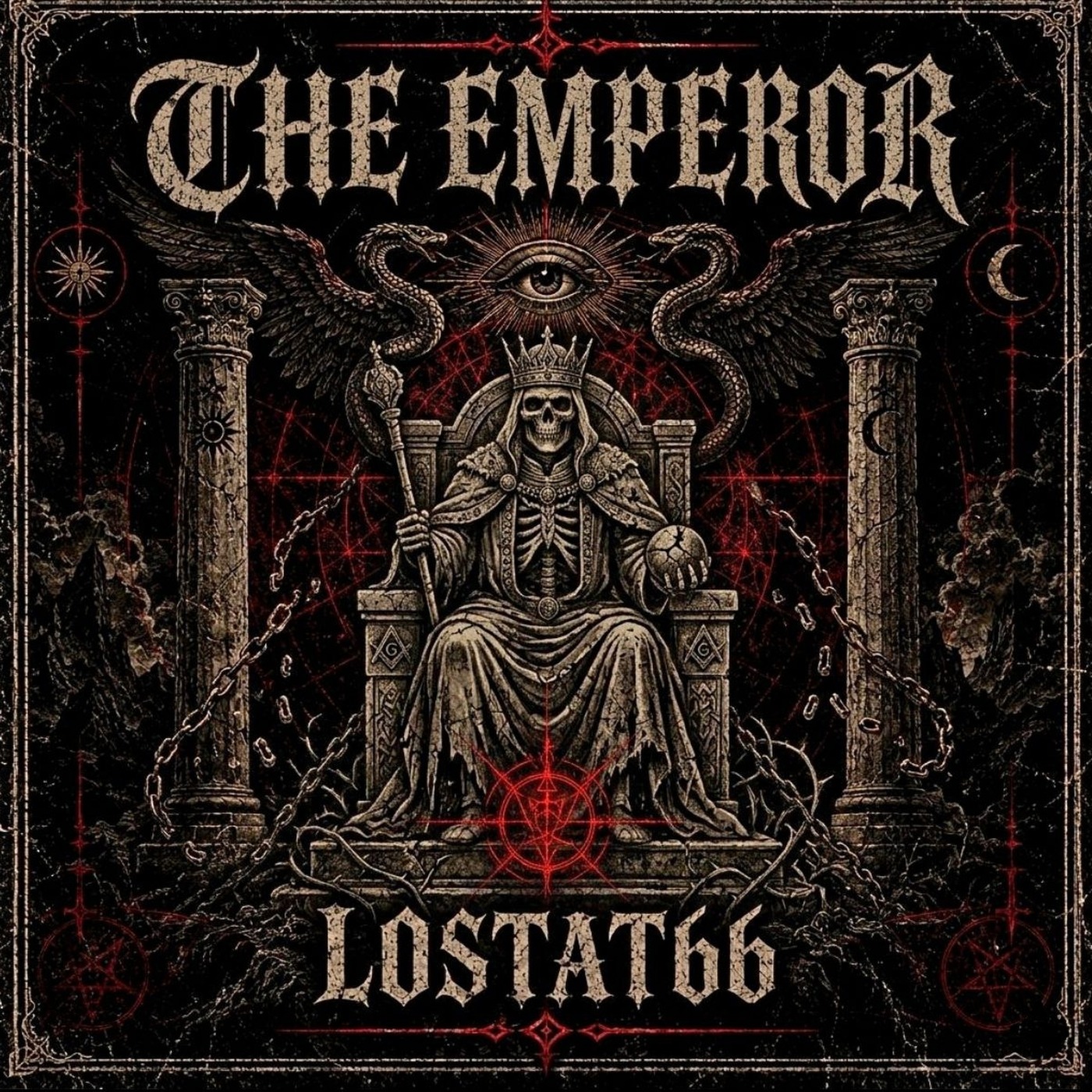 The Emperor
The crown is made from promises, and the man beneath it cannot bear the weight. The Crown I Couldn't Carry opens with the gap between wanting authority and accepting what authority asks. The lyric refuses the old explanations that called failure fate and the inability to keep peace war. Respect cannot be demanded while responsibility is avoided.
The turn is not to find a heavier crown. It is to let the throne fall and build the person first. Fragments and unfinished promises become materials for a foundation instead of reasons to keep blaming the world. Within The Emperor, this admission is the first honest act of strength. The song does not make failure disappear; it removes the performance that kept failure from becoming useful knowledge. The crown can wait. What matters is the man who will eventually have to carry it without asking others to carry him.
The man being buried wears the narrator's own face. The Man I Buried follows a former self sustained by lies, resentment and the habit of calling destruction freedom. The lyric does not deny that he existed. It recognises how often pain became a throne from which to demand that everyone else pay.
The grave is symbolic: the end of a way of living, not the destruction of the human being who has to continue. That distinction keeps the song connected to Do Not Resuscitate while allowing The Emperor's responsibility to deepen it. Remembering does not require resurrection. Refusing to become that man again does not require hating him forever. Revenge appears as another prison, with the key too close for the narrator to keep pretending it belongs elsewhere. The track closes its grave so the work can begin, leaving the person alive to do something different with what remains.
Waiting becomes its own enclosure in No One Is Coming. The lyric places the narrator at a door, hoping for rescue while the hours become years. The song's severity is aimed at that suspended agency, not at the human need for care. The change comes when the person waiting finds his own feet and begins to understand what another life will require of him.
Within The Emperor, this is lonely responsibility turning towards work. A different future cannot remain entirely dependent on someone else arriving to carry it across the threshold. The final possibility is not only standing alone. It is becoming the man who stays and the one who holds the door. That matters to LOSTAT66's wider purpose: self-government is not supposed to make a sealed fortress. It should make someone capable of acting, remaining, and eventually leaving an entrance open without waiting to be remade from outside.
A name begins as a word. Trust makes it heavier. The Weight of My Name follows the movement from fleeing that weight to standing behind it, letting every letter ask what the person carrying it is willing to do. The lyric separates a name from inheritance and turns it towards responsibility: what is said must be answered for, and what is broken must be faced honestly enough to rebuild.
The song does not ask for perfection or unanimous recognition. Being misunderstood by the world is different from refusing to know the difference between the self and the performance. Within The Emperor, identity acquires a measure that does not depend on applause. It rests in the choices made under the name. The iron in that image is not a crown used to dominate others. It is the burden the narrator is finally willing to put his own hands beneath.
Working Man gives discipline a task beyond thinking about discipline. Daily physical labour directs the chapter's rebuilding into something done, repeated and answered for. The self is not remade only by understanding the ruins. It also needs a way to meet the ordinary day without waiting for a defining moment to make the work feel possible.
Within The Emperor, the track holds the difference between declaring an identity and living it. A promise can be spoken once. Its meaning has to survive repetition. The song's place in the album brings responsibility down from the throne and towards the scale of actual effort, without inventing a workplace or occupation for the narrator. What matters is labour as direction. The person who wanted a kingdom has to become capable of building, and building asks for more than the feeling of being ready when the tools are first placed in his hands.
The promise returns with fewer illusions in The Oath. The lyric admits earlier promises turning to dust and refuses to replace them with an impossible guarantee of perfection. Instead, it offers presence: staying when fear returns, learning after failure, continuing without selling the self for someone else's love or approval.
This is commitment revisited after the destructive obligation heard in earlier chambers. The word still matters, but it is no longer meant to consume the person keeping it. The addressee is not the crowd or the ghosts. It is the man in the mirror, including the moments when nobody else can hear. Within The Emperor, that smaller promise carries a deeper weight than display. What happened cannot be rewritten, yet what happens next can be chosen. The song makes the Oath a practice of becoming trustworthy to oneself rather than another demand to become untouched by life.
Anyone can promise when the promise costs nothing. A Man Keeps His Word places integrity where the easy road begins to offer relief, where nobody would know if the commitment were abandoned. The lyric gives character a measure outside performance: what remains when there is no audience and nothing obvious left to win.
Its narrator does not speak from an unbroken record of goodness. Broken promises and disappointment remain part of the account. Shame alone cannot build their replacement. Following through has to become an action rather than another punishment. Within The Emperor, this is one of the ways responsibility becomes human instead of immaculate. Trust survives through imperfect lives made more dependable, not through the fiction that a person has never failed. The song's demand is severe because it is ordinary: do not only tell the world who you are. Let the word survive the moment when keeping it hurts.
Hands are remembered before explanations in The Man Who Taught Me. The lyric honours someone whose example made strength visible without cruelty: standing between danger and loved people, carrying pain without passing it on, and knowing when gentleness is what strength requires. Grief changes that memory into a mirror, making the weight of those quiet lessons clearer over time.
The song does not identify this person, and its meaning does not depend on assigning a family role or biography to the absence. What matters is the standard left behind and the narrator's decision to carry it forward without pretending to become the same man. Within The Emperor, responsibility is not built only from self-reproach. It can also be received through love and example. The promise is to honour what was shown in the way the living person chooses to stand, protect and remain gentle now.
No convenient enemy remains in the room in The Mirror. The lyric looks towards the boy abandoned, the promises defeated and the choices that cannot be hidden behind another person's name. But the reflection is not asked to deliver another punishment. It is asked to make change possible. Accountability and self-hatred are no longer allowed to mean the same thing.
This distinction gives the track its place in The Emperor. Discipline can become another mask if it only makes condemnation appear respectable. The narrator has to stay with what he sees without using the damage as permission to remain unchanged. He is not reduced to his worst mistake; he is responsible for what he does next. The mirror's clarity is therefore different from the inward surveillance of Nine of Swords. Seeing can become a way to remain present with the self, not merely another reason to turn against him.
The title track removes conquest from the crown. The Emperor names authority over the self: anger, fear, appetite, boundaries and the promises kept when nobody is watching. Power no longer means owning the room. It means being answerable for what the narrator allows to govern him, and for what he refuses to become.
The lyric gives walls a different purpose too. They are not simply there to keep the world away, but to distinguish what may enter from what cannot remain. Mercy does not cancel strength. Saying no does not cancel love. Within the wider story, these are hard-earned distinctions after bondage and fracture, not the attributes of a person who never fell. The song's claim is grounded in choices made repeatedly. Even if the crown is lost tomorrow, the practice of self-government can remain. The throne itself was never what needed to be saved.
One brick follows another in The Kingdom I Built. What begins among broken stone becomes a life measured less by grandeur than by what can be lived inside it: a quiet room, a conscience that can be faced, and love that does not require the self to disappear. A castle would not make those things more real.
Within The Emperor, this track brings the chapter's ordinary work into a structure worth protecting. Promises and trust matter because they determine what happens within the walls, not because the walls appear imposing. That distinction carries the album away from domination and towards the wider Temple's unfinished purpose. A building cannot prove freedom merely by remaining upright. Its life matters. The song lets the scale become human, honouring what has been built from what remained without turning the builder into a conqueror or claiming that every room has already found its final shape.
A Kingdom Within closes The Emperor by bringing order beneath the feet rather than over another person's head. The inward structure becomes a stable floor, not another coffin. The chapter's discipline has to support life instead of merely containing it, or the crown will have changed its appearance without changing what it asks of the person carrying it.
The track gathers the preceding work without announcing that becoming is finished. Failure has been admitted, words have been given weight, boundaries have begun to hold, and responsibility has acquired a daily scale. Now that capacity must remain habitable. In the wider descent, Welcome to Anhedonia revisits earlier rooms before The World brings the Tarot cycle into integration. This closing song leaves the listener with something capable of standing through that return: not a perfect man or a completed Temple, but an inward ground that does not need to bury the person it supports.
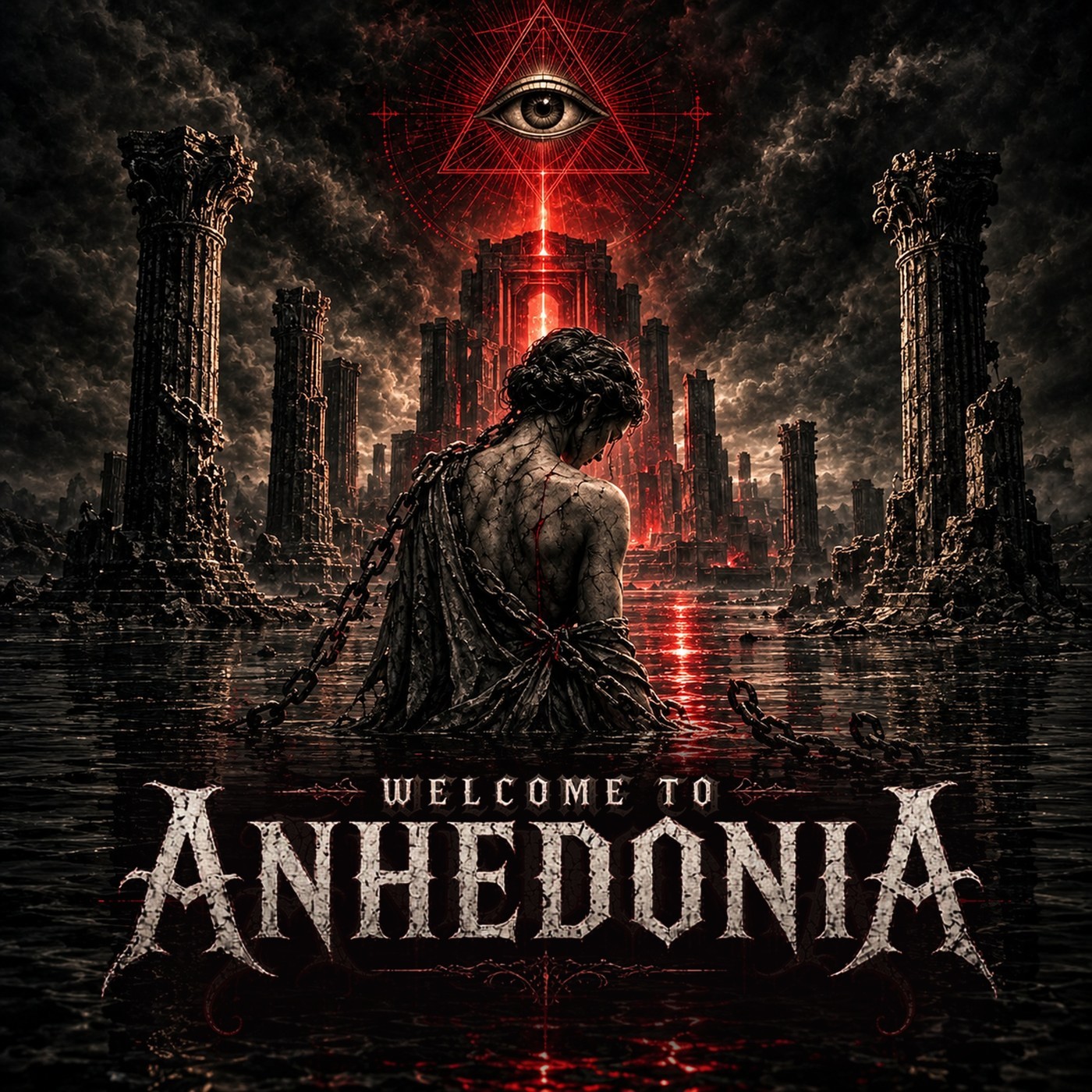 Welcome to Anhedonia
The title meets a lyric that carefully changes its meaning. Sacrifice My Heart does not glorify giving the self away. Its central distinction is between losing the heart and letting go of what has been killing it: excuses, numbness, familiar pain, the need to win and the armour that confuses silence with strength. The cost is real without making self-destruction the price of becoming.
The song allows former selves to rest rather than requiring hatred as proof that the narrator has moved on. Some things carried him this far without being able to carry him home. Within Welcome to Anhedonia, this places an act of choosing at the entrance to the return through memory. The past will be heard, but not every old demand must be obeyed again. The quieter setting does not remove the difficulty of the decision. It makes room to hear what is finally being left at the altar.
The title track enters a life whose outward signs continue while feeling withdraws. Coffee cools. Conversation is answered by reflex. A smile becomes another task completed for the people watching. Welcome to Anhedonia gives that distance its own language, including the unsettling wish to feel an old pain simply because pain once proved that something was still awake.
The lyric refuses the fiction of a single moment that explains the disappearance. The narrator has given pieces away gradually, then built a Temple from what could not be saved. The descent continues beneath the floor that once seemed final. Within the album, this is the chamber's central absence, not a promise that numbness is the truth of every life forever. The song lets the state speak without dressing it as peace. Being alive and feeling alive remain painfully separate, and the words make that separation something another person can recognise.
A Crossroads Debt Paid returns to the road with memory still present. The same dark sky and three missed texts remain within the lyric, but the returning voice is not simply replaying the first surrender. A debt that once seemed settled has continued breathing under the skin, and the narrator has come back to see what survived beneath the wreckage.
The dialogue keeps its unease. The Oath has not become an innocent phrase merely because it is remembered more clearly. What changes is the claim made over what followed it: the hands that built the next part of the life are not surrendered with the old shame. Within Welcome to Anhedonia, the return allows a different distinction to be heard. Memory is not ownership. The road can retain its footprints without taking the future too. The deeper terms remain in shadow while the narrator keeps moving beyond the point that once defined him.
Night tells a story the narrator knows not to trust. Moons Illusions revisits the lyric world of The Moon's Lie, where rooms seem to shift, familiar faces become uncertain and failure acquires colours daylight would not give it. The voice says he is finished. He recognises the deception and still almost believes it again.
That repeated return to belief is the song's human pressure. Insight does not always make the feeling yield. Within Welcome to Anhedonia, the acoustic reimagining belongs to an album that softens its edges without removing its darkness. The words remain caught between recognition and the force of the night speaking over it. This is not a supernatural explanation for the narrator's distress, or a claim that its conclusions are true. It is a chamber where the difference between knowing and feeling becomes difficult to keep steady, and where resistance can exist even before the voice has fallen silent.
Ghosts listens to the things that did not remain where they were buried. Begged-for love, chemical nights, promises postponed until tomorrow and former selves abandoned in the effort to keep living gather inside the lyric. Their voices know the narrator's name. For a long time, that familiarity has sounded like a right to decide his future.
The song changes the relationship without pretending to remove the past. The ghosts can remain in photographs, scars and rooms no longer visited. They do not get to write the next road. Within Welcome to Anhedonia, this is memory given space without being given the whole life. What once appeared monstrous can also be recognised as hurt pieces of the self that were not understood. The refrain's survival does not depend on proving the ghosts unreal. They are still here, and the narrator is here too. Presence begins to answer ownership rather than merely endure it.
Echoes Gone revisits the lyric of being already absent from a body that continues to appear. Machines can register a pulse while the narrator feels the life moving without him. Conversations are met at the right moments, food loses its meaning and the days repeat a grey weight that no longer feels like an event worth naming.
The song does not present that exhausted voice as a final measure of the person speaking. It makes dissociation and numbness audible from within their own narrowed perspective. In Welcome to Anhedonia, the return matters because softer surroundings do not automatically make such words gentler. A familiar room can still feel like the scene of a life no longer inhabited. The track stays with that distance without calling absence peace or demanding that the night resolve itself before it can be heard. Its testimony is severe, but testimony creates the possibility of recognition where private silence had made the absence seem unshareable.
The weight has not become abstract in Weight Revisited. The lyric returns to cold coffee, unanswered contact, bills and the mechanical effort of moving through hours that no longer seem to land on anything meaningful. The body is imagined as borrowed, carrying a life whose name has grown unfamiliar. The title marks a return, not a claim that the burden was understood completely the first time.
Within Welcome to Anhedonia, this revisiting lets the earlier Dead Weight material speak in the album's more intimate frame. The objects are ordinary, which makes the absence harder to keep at a safe symbolic distance. The song does not turn the narrator's self-description into a verdict that he is truly worthless. It holds the feeling at the point where that verdict has become persuasive. The wider Temple is being built so such weight can be acknowledged without requiring the person carrying it to become the weight itself.
The western door opens onto a building that remembers everything brought inside. The Sound Kept by a Temple carries the wreckage of the Crossroads towards twin pillars, an unclosing eye and a geometry of stone and debt. The narrator searches for a lost word but encounters the sound he cannot forget. The unfinished structure has become a witness that offers no easy absolution.
The lyric's Temple is still empty enough to feel like enclosure. Walls close as judgment; silence becomes the material around the person trying to speak. Within Welcome to Anhedonia, this is an ending that keeps the earlier architecture audible rather than claiming it has already become refuge. It must not be confused with the later song The Temple, where the purpose of the walls begins to change. Here, the sound remains held in stone. The need to build differently is still something the wider journey has to face.
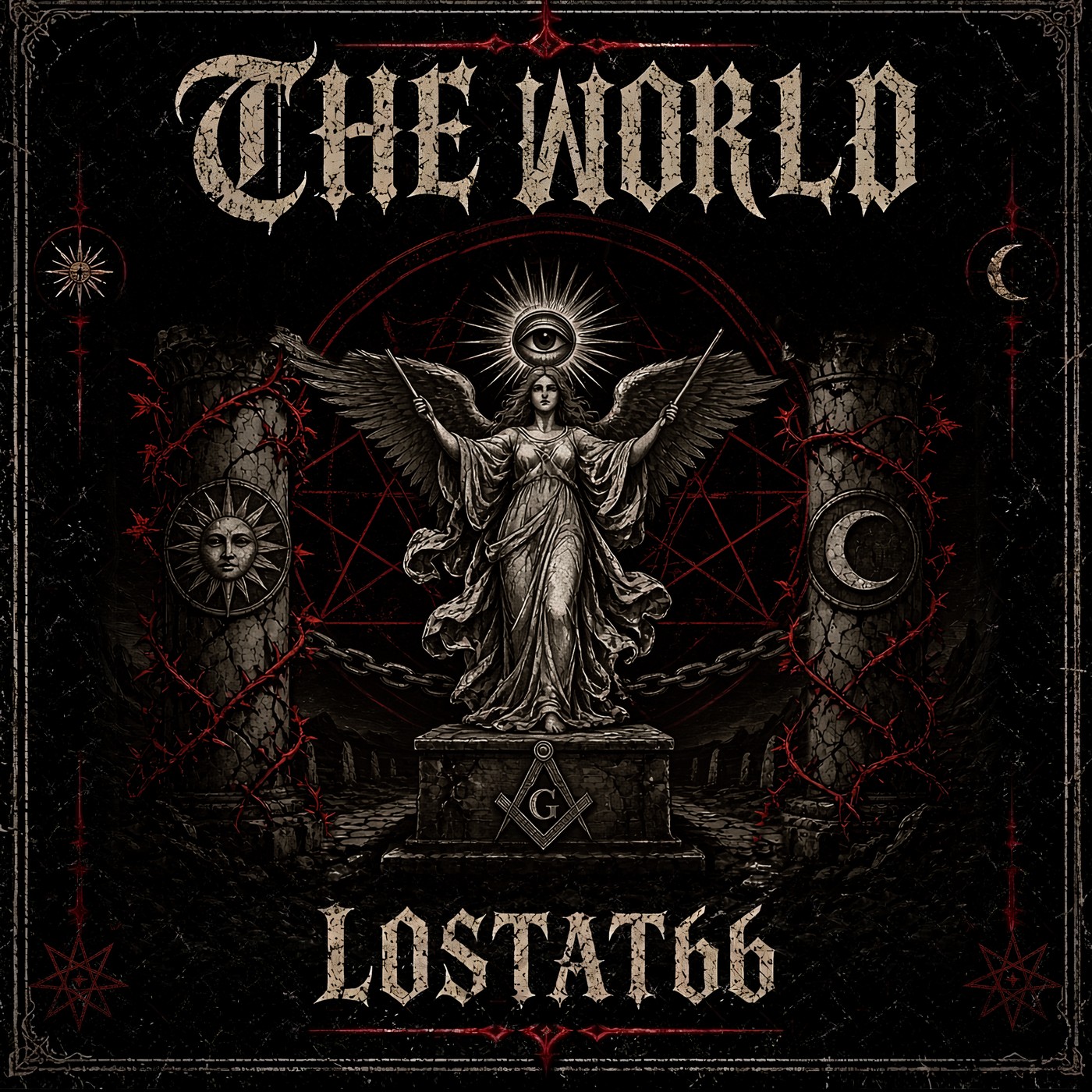 The World
The ghosts are still here, but their presence is no longer accepted as ownership. All My Ghosts opens The World with the residue of begged-for love, chemical nights, broken promises and the years fed to voices that kept saying the narrator was not enough. The lyric speaks in fragments, making the memories arrive as pressure rather than arranging them into a comfortably distant account.
The turn is survival made audible. Being hurt is separated from being empty; being lost from being beyond a future. The narrator does not announce an exorcism. The ghosts can remain in history, scars and the places already passed through without being allowed to write what comes next. As the first track of the final Tarot card, the song establishes the album's kind of completion: not the removal of every haunting, but the beginning of a different relationship with what still knows the person's name.
The Boy in the Dark turns towards the younger self who learned to become smaller, read danger in silence and confuse being needed with being loved. The lyric does not ask that boy to prove how much he survived. It returns to him with the recognition the older voice had withheld: he was not the enemy, the burden or the thing that broke.
That act changes the meaning of strength. Becoming a man cannot depend on abandoning the frightened child inside the man. The narrator apologises for that abandonment and refuses to build another altar from the boy's pain. Within The World, the song is a necessary movement towards integration: a former self is not merely tolerated as evidence of damage, but given a place to belong. The protection once demanded from outside becomes a decision to remain. The boy no longer has to carry the whole life alone.
The lyric begins with a burden mistaken for care. What I Could Not Save asks whether setting something down really means it mattered less, then separates love from the impossible duty of making every ending different. People, lost years, broken promises and former selves remain meaningful even when they cannot be carried back to life.
The song refuses both erasure and permanent self-sentencing. Knowing more now does not give the narrator the power to return to every earlier choice and remake it. Compassion must extend towards the man who acted with what he knew then. Within The World, this becomes one of integration's hardest boundaries: remembering without returning, mourning without surrendering the present, caring without losing the self inside another person's pain. Letting rest is not the same as declaring the loss worthless. The song puts down blame so that love does not have to keep living in the grave.
Freedom arrives without the spectacle the narrator expected. In The Chains Are Gone, there is no thunder to certify the change, no rescuing hand required to make it real. He reaches for the familiar restraint and finds that the old lock is no longer what holds the life in place. The door was open. Walking through it remains a choice.
The lyric moves through anger, addiction, fear and the need for an apology that would finally authorise healing. It recognises how a throne can be built inside the head for a figure who no longer needs to bar the doorway. Within The World, the song does not deny that bondage happened. It changes what the past is allowed to possess now. The frightening part becomes freedom itself: without the chain as explanation, direction has to be chosen. The narrator can stand without kneeling to what once controlled him.
Sacrifice begins by changing the question of cost. Not whether something will be paid, but what the narrator is willing to stop carrying. The lyric lays down excuses, familiar pain, numbness, pride and the need to win every argument as proof of survival. What must be lost is not the heart. It is what has been killing the heart while calling itself protection.
The song also dismantles a hard, isolating account of masculinity. Needing help, crying, apologising and admitting uncertainty are not failures of strength. The old armour has been keeping human life outside. Within The World, sacrifice becomes an act of choosing what survives rather than disappearing for the sake of an obligation. Former selves are allowed to rest without being hated. The past matters, but it cannot keep claiming the whole future as payment. Something is left at the altar so the living person can walk away.
The doors open inward in Every Piece of Me. The lyric gathers the angry self, the frightened self, the one who stayed too long, the one who ran and the boy who learned to disappear. Growth no longer requires cutting away every part that carries a difficult history. The narrator can keep a lesson while dropping its shame, keep the fire without keeping the war.
This is the centre of The World's integration. The former selves are not restored to command, but they are no longer denied a place in the life they helped carry this far. Anger and fear can remain without taking the wheel. That distinction changes the Temple's architecture: a monument to what could not be said can become something more habitable when its rooms stop being sealed against the people who lived there. The song chooses understanding over another mask, and belonging over another act of self-abandonment.
The weapons in No More War are names, remembered words, grudges and the voice that keeps putting the self on trial. The lyric follows anger until it becomes a religion of its own, preserving the hurt through the very acts meant to defend against it. A fortress keeps danger outside and then cannot explain why nobody can come near.
The refusal that follows is not theatrical forgiveness. Nothing has to be excused or forgotten for the narrator to stop giving it another morning. The song asks a hand accustomed to holding a weapon to learn how to open. Within The World, that is part of making survival livable: the evidence is being here, not the willingness to continue prosecuting the self forever. The battlefield can remain in history without the person becoming another battlefield. Peace begins awkwardly, as something put down before it feels natural to stand without it.
The Man I Became refuses the fantasy that the right future must restore an untouched former self. The lyric looks into a mirror and sees history without asking the reflection for permission to exist. The person standing there has been built through boundaries, words kept, nights survived and the choice not to become what hurt him.
The song does not hate the harder man who once kept the narrator alive. It thanks him and releases him from permanent watch. That distinction lets strength become more than the ability to swallow pain without showing it. Within The World, survival can remain the foundation without being forced to serve as the whole house. The boy, the fighter and the broken man can stand beside the present self rather than compete to govern it. The title names an act of recognition, not a claim that becoming has finally stopped or that every wound has disappeared.
Morning comes without asking whether the narrator can bear it. The World Is Still Turning lets light find the room and the birds continue while the life inside that room struggles with everything it has carried. The lyric does not make the world's persistence an easy comfort. At first, it exposes the distance between the scale of private suffering and a day that continues anyway.
Then something underneath the weight answers: not yet. Survival becomes the fact from which another step can be taken, not proof that anything grew easy. The song begins to release the idea that carrying every loss is what gives those losses meaning. Some things need rest rather than another answer. Within The World, opening the door does not certify that the room is fixed. It allows the person to move while the past remains real, and to stop mistaking yesterday's pain for a debt owed by every morning that follows.
The lock has come loose, yet the key is still being carried. The Weight of the Key follows that contradiction into a life built around what was killing it. The narrator knows what made the wound and can name who struck the match, but knowledge alone does not make him whole. The Devil never needed to bar the doorway if powerlessness could be made to feel like truth.
The lyric turns responsibility towards the ordinary: a boundary held, a truth confessed, a night met without escape. Freedom does not have to arrive as a sudden remaking of the person. It can ask for a small choice that no one else can make. Within The World, the open door becomes more demanding than the imagined locked one. The past belongs to the narrator, but it cannot own the life. He stops asking what rescue might do and takes the step himself.
The title track gathers the cards without leaving their damage outside. The Oath, the Devil's face, the ghosts, the prison of the mind and the unfinished Temple all return within one account of survival. The lyric does not call that account a crown or a throne. It calls it the person who made it through without having to become a stranger to every broken part.
Each Tarot stage is recognised as part of the whole: the night survived, the other side faced, the choice learned, the structure built. Integration means the boy can remain beside the man and the scars can remain on the hands that build a meaningful life. Within the album, this is completion spoken precisely enough not to become perfection. The foundation can be strong while the Temple is unfinished. Nothing in the person has to be left outside merely to make the ending look clean.
The name returns after the cards have been faced. Lost at Sixty-Six gathers fear, chain, choice and responsibility into self-recognition: the person no longer needs to keep becoming other men in order to imagine he might be enough. What has been carried can be acknowledged without being appointed the permanent ruler of what comes next.
Its place after the title track brings the whole cycle back towards LOSTAT66's threshold. The name remains a question worth entering, not a numerical solution handed over at the end. The cipher belongs to this mythology, and the song does not need a claim about history to make the meeting of former and becoming selves meaningful. Within The World, being able to recognise the self also creates the capacity to put weight down. The journey has not produced invulnerability. It has made room for the person who can remain without repeating every old demand.
The bonus track keeps the absence of feeling in view. Welcome to Anhedonia follows a person whose body continues the familiar motions while the connection to being alive grows remote. Cold coffee, reflex answers and a mask worn until it fits give numbness an ordinary scale. The descent is not a single shattering event; the lyric names a disappearance happening a little each day.
Its Temple is built from what could not be saved, with memories laid on the altar and silence extending beneath the apparent floor. Those images are testimony to a state, not an instruction to accept its bleakest claims as destiny. As a bonus on The World, the song stands beside the closing Tarot account without replacing its integration with a false claim that nothing changed. A completed cycle does not require difficult experience to be disowned. The album can make room for this voice without giving it the whole ending.
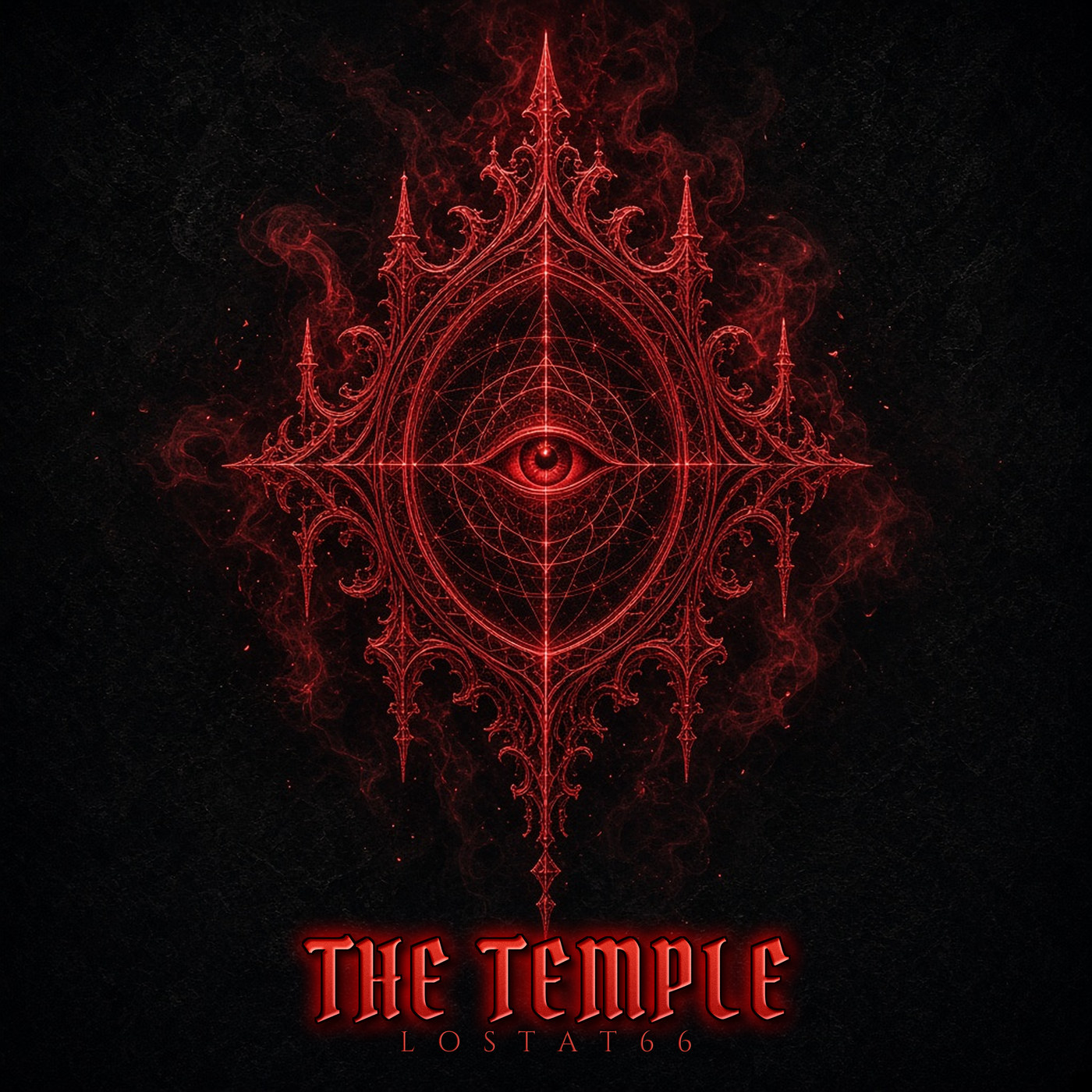 The Temple
It starts back at the crossroads, two roads under a blood red sky, one leading into darkness and one leading inside, and the first confession is that he thought he knew the difference. What follows is the building. He fills every room with enough noise that the silence can't speak, lays another stone over whatever he can't face, and gives his ghosts a place to stay. He frames his wounds and calls them home. The walls go up against the world, and then he wonders why nobody can reach him: he has built a place nothing could destroy, and nothing living can come near it. The halls are full of faces, some he remembers and some he used to be, names buried in the plaster and old promises under the floor, and every time he tries to leave, there's another locked door. Then someone arrives. Not a warning and not a plea, just a stranger at the entrance carrying the same weight he couldn't see, who doesn't ask for salvation, only somewhere safe. For the first time in his life the walls become a choice. Pain is not a promise, and grief is not a chain. Stones can't make a man whole, so he leaves the door open and lets the cracks stay where they are. Nobody has to call it healed, make it beautiful or call it strength. They can set it down and stay until the silence softens. The walls can hold the weight, the door stays open, and the work goes on.
The second room turns the building outward. It opens on a question that belongs to anyone who has kept watch alone: who keeps the vigil when the keepers are lost, and who counts what it cost? He lays his bones between the stones, gives the voices somewhere to mourn, and follows the scar back to its buried source, only to find an altar he built out of loss, where the price was his. The chorus is an invitation rather than a sermon. Lay your ghosts on this altar and let the weight fall from your bones; the broken need no halo, and the damned don't need a tomb. Then comes the turn that gives the song its name. He hands over the tools. He built these walls from what destroyed him, but nobody else was born to build that way, so take the tools, rebuild your own temple and make a kingdom of your own. The verses carry the empathy that earned that offer: the hurt he can hear underneath someone's wrath, the hand he keeps extended where another would pull back, and a penance that means giving the voiceless their words back. He can't promise anyone peace. He can only build, stand beside the doorway, and tell them what's inside. He refuses to call the stone sacred just because it carries his blood.
The third room is the entrance, still cut open. He built it from the words he had swallowed so the voiceless would not have to cross alone, and if the walls were raised from sorrow, the cut stays open for more than him. Come cross where the threshold bleeds. The cut will not ask if you are healed, only whether you can set the weight down. Some lay it at the first stone and walk through; some stand and measure if the blood is real. Those who cross do not look back at the man holding the wound. This is not the altar. This is only the line. The door does not close. He remains on it, still open.
This is the song for the person who has been asked "are you all right?" so many times that the lie became their name. He knows that look because he's worn it home. He has answered every question without saying anything true, kept showing up for everyone while quietly disappearing, made the joke, changed the subject, and made the unbearable sound fine. But the body keeps the record. A thousand words, and not one he can let go of. The fury in the middle of the song is what that silence sounds like when it finally breaks. Then it softens into the confession at the heart of the whole album: he didn't find his peace in heaven, he found it where the words went to die. Some promises become the rope beneath you, and some debts survive the price you've paid, so he turned what he couldn't say into something you could hear. Now a stranger screams his buried words back at him, and for a moment he isn't alone. He still doesn't know how to ask for help himself. That's the truth, and the song doesn't pretend otherwise. What it offers is a room where you don't have to smile and you don't have to say you're all right. He can't promise the rain will end, but if his voice can reach you, you don't have to face it without a friend.
The closing ritual goes back to the crossroads, to the mouth of the world and the teeth of the flame, and counts the price of the oath. He asked for the tongues of the buried and unheard, and the price was the man who spoke for them. He judged his worth by the weight he could bear, and they called it devotion when there was nothing left. He carved himself hollow to give everyone else a home. Then the old road of ruin brings him back where it began, with no witnesses, no choir and no one left to convince, only the crossroads and the man he was expected to become. This time he answers. He will walk with the lost through the dark he knows, but he won't make a religion of sorrow. No wound is a crown, and no chain is a creed. Suffering isn't what makes something sacred, and he won't let anyone call his destruction devotion. The crossroads remain, the oath still has its cost, and he'll carry the name. But the wound is not worship, and the voice he gave to others has finally reached him. It closes on the work that isn't finished, still building the temple.
 The Resurrection
Light Season opens the EP within the possibility of more room after confinement. In LOSTAT66's established Resurrection chamber, light does not mean the darkness has been erased. It means the descent is no longer the only direction available. A life can begin to open while still carrying the knowledge of where it has been.
Emergence does not arrive as a sudden cure or a command to make the whole past innocent. After the Tarot cycle, the person has not been returned to innocence. The past can remain visible without filling the whole field of vision. As the first track here, Light Season gives that change a threshold: the possibility of entering another stretch of life without pretending every earlier room has stopped existing. The Temple is unfinished, but there can already be air moving through the places that once felt sealed.
What remains after the descent cannot be reduced to what has been lost. Everything Left sits within The Resurrection's movement towards beginning again, where the self has to meet the materials still in its hands. Survival leaves knowledge as well as scars. Integration leaves a person with a life to continue, not simply a past to explain.
The remainder can be faced without asking every broken part to explain itself before it is allowed to stay. Within this EP's place in the larger journey, what is left can become the ground for another choice. The person does not have to return to an earlier self to deserve a future. The track's position asks the listener to remain with what survived, neither worshipping it as damage nor discarding it because it is not untouched. Building begins from what is here, and what is here need not be the same as nothing.
Growing Pains keeps change from being mistaken for ease. Its title belongs naturally within The Resurrection's established refusal of instant transformation: a beginning can be real while still uncomfortable, and a person can move beyond an old pattern without knowing at once how to stand in the space it occupied.
In the wider LOSTAT66 story, that distinction prevents emergence from becoming another impossible standard. The person has already lived through promises that could turn against him. Growth cannot simply be a demand to stop feeling the weight before he is allowed to continue. This track's place lets difficulty remain within the movement forward rather than treating difficulty as proof of failure. The Temple's unfinished state carries the same honesty. Work remains because becoming remains. The change does not have to be painless to matter, and the pain does not have to become the reason the person is forbidden to grow.
Still Here closes The Resurrection on presence rather than invulnerability. The words can carry knowledge without turning knowledge into a claim that the next day will be easy. In the EP's established story, the person returns with what the descent has taught, not as a restored version of someone who never needed to enter it.
That gives this title a different horizon from the exhausted continuations heard in earlier chapters. Its place after the Tarot allows being here to open towards another life, while the work remains ordinary and unfinished. The established interludes come next, followed by The Final Chapter's release. Nothing needs to be rushed into a triumphant ending. The track leaves the listener with a fact large enough to begin from: presence remains. The Temple can be built for people still becoming, and the story can keep moving without asking them to have finished before they arrive.
 Slow Climb
 belongs between The Resurrection and The Final Chapter. Its place keeps emergence from becoming an instant ending. A person can come through the descent and still have to meet the next stretch of the path at a human pace. The title holds movement without demanding that the movement become spectacle.
Slowness is not automatically failure. The wider Temple is being built one decision at a time, and the distance travelled cannot always be measured from outside. This interlude gives continuation a place before the weight can finally leave the hands. The story has already supplied enough weight to understand why another step matters. What follows is release, but the passage towards it remains something a living person has to move through rather than an ending declared on his behalf. The road does not become meaningless because it is being taken slowly.
 Struggling to Breathe
The remaster returns Struggling to Breathe to the listener as another edition of the same song. It remains beside the original and acoustic versions in the passage after The Resurrection and before The Final Chapter. A return does not always mean a new event. Sometimes it means making room to meet what has already been carried with a different distance between the work and the ear.
The interlude keeps the effort of living visible while the larger story moves towards putting weight down. Nothing about returning to a song requires the narrator to stand beyond all difficulty. The person at the centre remains human, still between emergence and release, while the unfinished Temple leaves room for another breath. The words of a title can remain recognisable through another presentation without becoming a verdict that the journey has failed, or a promise that every part of it has now been resolved.
Struggling to Breathe holds the interlude passage after The Resurrection and before The Final Chapter. Difficulty stays in the room after emergence. Another beginning does not have to prove itself by becoming easy. Breath can continue while the effort of continuing remains real, close enough to be felt without being turned into another test of worth.
The original single begins a family of editions that also includes the acoustic version and remaster. Within the wider journey, its place is one of persistence before release. The person has not been returned untouched from the earlier chambers. He still needs room, time and somewhere for the weight to exist without becoming the whole name. The Temple's purpose remains aligned with that human scale: a place to catch breath, not a demand to demonstrate invulnerability before the door is opened. Presence is enough to begin from, even when it still takes effort to remain.
The acoustic version carries Struggling to Breathe through another form without making it another beginning for the story. Its place remains with the interludes between The Resurrection and The Final Chapter, where continuing can be acknowledged without borrowing release before the person is able to feel it. The same song can be returned to without asking the person inside it to have become someone entirely new.
What remains central is the human effort held by the title. One chamber passed does not make the next day weightless. A familiar threshold can be approached again while still belonging to the same road. Here the listener can stay with that continuity, finding another way to meet the song without needing to erase what it has already carried. The Temple's work has never depended on the fiction of a single step after which breath would require no room at all.
 The Final Chapter Baptism
The opening vocabulary returns with a changed relation to it. Crossroads Oath Reclaimed places the Oath within The Final Chapter's established meaning of release, allowing the beginning to be faced without requiring the person to remain forever at its breaking point. Reclaiming is not the same as pretending the original promise had no cost.
The deeper terms remain unspoken. The Crossroads still belongs to the origin; its weight is not removed to manufacture a clean conclusion. What can change is who gets to decide how the promise is carried now. Within the EP, that possibility makes the return more than repetition. The narrator can meet an old symbol without handing it another lifetime. The story begins to emerge from the road it once entered, and the Oath can be remembered without becoming the only voice allowed to tell the person who he must remain.
Temple Restored must not be mistaken for a completed sanctuary. The title belongs to a story in which rebuilding never makes the human being finished. Restoration can mean returning purpose to what has been built, letting a structure serve life rather than continuing to preserve the conditions that made life feel enclosed.
Within The Final Chapter, restoration turns towards release. The Temple is not made meaningful by hiding every crack or removing every sign of the journey. It is meaningful because what has been carried can begin to be set down there. No finished architecture, instant cure or permanent state of peace is claimed. The larger project is still building somewhere capable of holding the weight. This track's place allows restoration to be understood as a changed relationship with the building, not a declaration that the scaffolds have gone or that the work no longer needs living hands.
The title breaks something the opening record left standing. The Ritual Broken returns to the vocabulary of The Ritual Is All That's Left while leaving the old forms behind. Within LOSTAT66's established symbolism, a repeated act can preserve commitment, and it can also continue after its human purpose has been lost.
Here, in The Final Chapter's movement towards release, breaking can be approached as the refusal to keep repetition in command merely because it has become familiar. The act is not made weightless by being called ritual. Its place in the life still has to be answered for. This track's title lets the larger story loosen its dependence on an old form without pretending the form was never meaningful. Something can matter and still need to end. The person can continue without proving devotion through another turn of the same enclosure or another offering to what has already cost enough.
His Name places naming inside a chapter where faith and release have personal meaning. The voice can turn towards meaning without forcing the entire road into a single explanation. Here is a movement beyond the self's old verdicts, where the language of meaning need not be limited to shame, debt and the names that once made the person feel trapped.
Across LOSTAT66, names can wound, define, be lost, be carried and finally be answered for. Here, the EP allows naming to face towards faith without asking that faith to speak for every listener or every other album. The track belongs to a human reckoning, not a conversion of the entire project into one genre of declaration. Its place holds the possibility that a name can offer more than another sentence against the person trying to put down the past.
Baptism closes the EP within its established movement of personal faith and release. What follows is not a life untouched by what came before, but a life no longer required to pay the same debt each day. In LOSTAT66's wider story, an ending matters because of what it allows the living person to stop carrying, not because it makes the past disappear from the record.
The Crossroads is the point of entering. This closing track belongs to the possibility of emerging. The two do not cancel each other; they let the scale of the journey be seen. Whatever can be laid down has mattered enough to weigh upon the hands. Putting it down does not declare it worthless. Beyond this chapter, the Temple remains unfinished, capable of holding a continuing story rather than embalming a perfect conclusion. The title leaves release with its personal meaning while the human work of becoming remains open to another day.
 Serpent and the Apple
Tracklist
 Grippy Socks
Grippy socks stands outside the main LOSTAT66 path as a bonus. The ordered descent has its own weight, but it is not the only way a listener can meet the work. Here a recording can remain beside the sequence without being made another compulsory step between the Crossroads and the unfinished Temple.
That space matters in a world built from words that carry more than their first outline. Not every title has to be unfolded into a complete account before the music is allowed to be heard. The Temple can hold a fragment without insisting it become a whole room, and the listener can enter by listening rather than by knowing every connection in advance. The bonus remains its own encounter. It does not alter where the story begins or declare a new destination. Something can belong to LOSTAT66 without being made to bear the entire architecture alone.
 Grippy socks alt
 keeps its own place among the bonuses, beside Grippy socks and outside the main story order. The alternate can be met without being turned into another card, another oath or another stage that the person must pass through before reaching the Temple. Its place is alongside the path, not laid across it as a new demand.
LOSTAT66's larger world has room for that distinction. A sequence gives the descent a shape, but shape does not require every recording to perform the same work. The listener can remain with a title, a voice and the act of returning without being handed a finished account of what must be found there. This bonus leaves the main architecture intact while taking its own space beside it. The Temple remains under construction, and not everything that belongs to the building must become another wall.
 The Second She's Around
 stands among the off-story bonuses rather than inside the Tarot's account of attachment. Its title can remain an opening, not an instruction to place another person or another bond inside the main descent. The listener is allowed to meet the song without being told that every voice belongs to the same chamber.
The Lovers already has its own path through surrender, fracture and the work that follows. This bonus does not need to borrow that sequence in order to have a place in LOSTAT66. Something can stand beside a continuous world without becoming another explanation of every part of it. Here the recording keeps that independence. The larger road still begins at the Crossroads and the Temple remains unfinished ahead, while the song can be heard on its own terms, without being made the missing piece of a story that has not asked it to serve that purpose.
The songs are the testimony the stone cannot give on its own. Here the chapters can be met through the words and the weight they carry, from the Crossroads towards the rooms that follow. Listen to what returns: the Oath, the ghosts, the name, the walls, the difference between surviving and living. They do not keep one fixed meaning all the way down. The music is the doorway. What the listener recognises after entering is part of the living work.
Every record here is a chamber with its own air. Some are close and cold, built from fear that will not let the body rest. Some are loud with the chains. Some are stripped back until a single guitar has to carry the whole room. Heavy does not always mean loud. Sometimes the heaviest thing is a quiet line sung by someone who almost didn't stay.
The catalogue is not sorted by when the songs were released. It is sorted by where they belong. A record can arrive later and still sit near the beginning of the story, because the story was always larger than the order the world heard it in.
Listen for what returns. The Oath. The Temple. The ghosts. The name. The difference between breathing and living. These are not hooks. They are the load-bearing walls, and they carry the meaning across every chamber.
Start anywhere. But if you want the story, start at the Crossroads and keep going.
Outside
Released
The five Tarot works. A listening link is cut in only when that record is out.
Work
Sleeplessness. Fear. The weight inside the room.
Work
Bondage. The things that control us.
Work
Attachment, choice, fracture, and what remains.
Work
Discipline. The crown is heavy.
Work
The world kept turning. You lived.
Bonus · Outside the story
Not part of the path. These tracks sit outside the journey.