Tarot · I
Nine of Swords
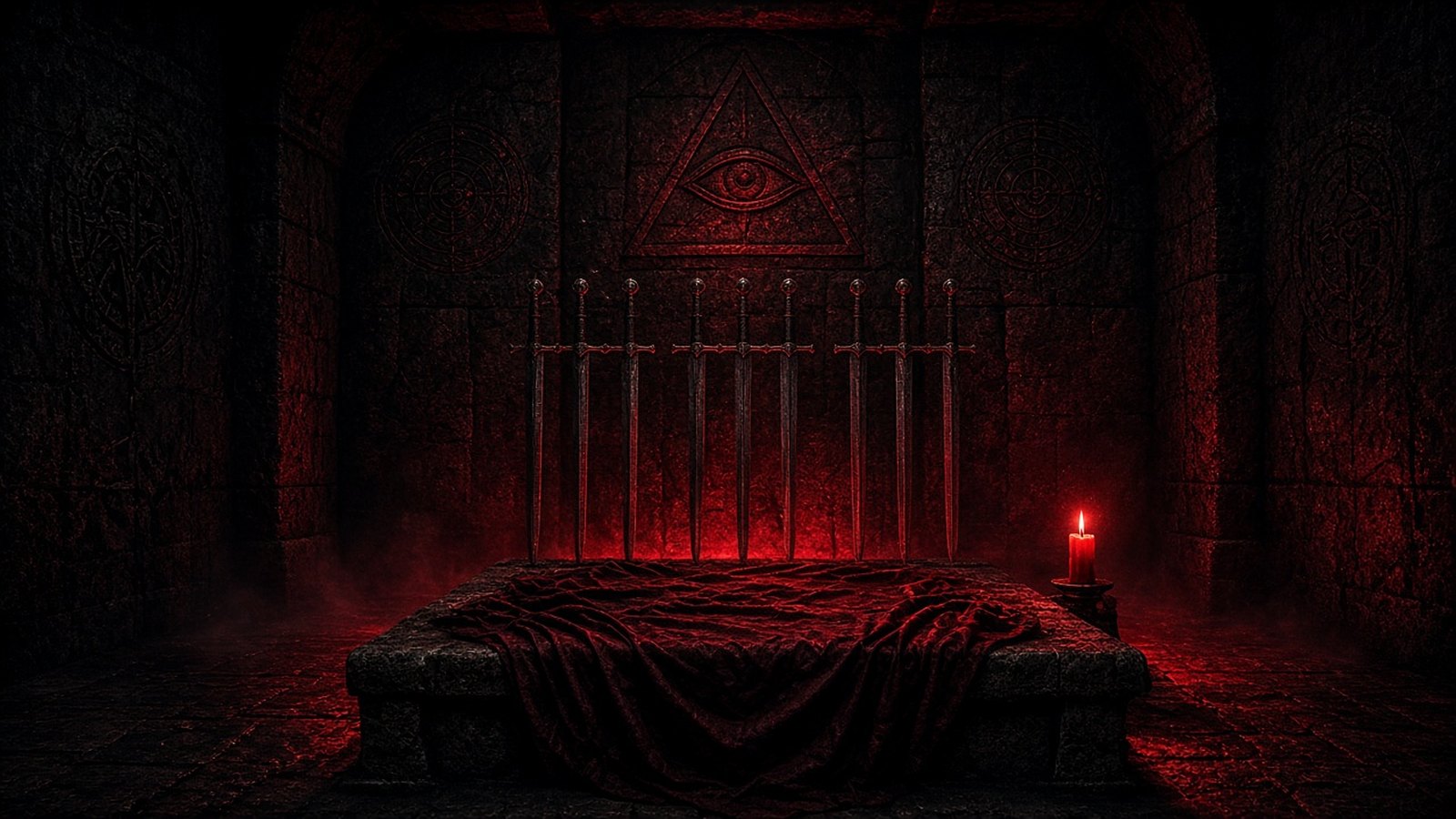
The first card is not the beginning. By the time Nine of Swords opens, the Crossroads has already been reached, the Oath has been made, and the opening passages have brought the listener to a doorway. Now the journey turns inward. What waits beyond it is not another road. It is the mind, awake with everything the road could not leave behind.
This released album begins the five-part Tarot cycle inside LOSTAT66's larger story. Fear, guilt, regret, intrusive thought and sleeplessness are its atmosphere, but the chamber is built from more than a list of feelings. The established ritual language becomes interior architecture. The Temple is no longer safely ahead as a distant destination. It is worn, inhabited, breathed. What looked like a structure becomes a way of understanding the body carrying it.
Across thirteen tracks, belief and identity lose their clean outlines. A name threatens what once held it. Roles fail to settle the question of who remains. Words that should order experience leave silence in their place. Judgment is no longer only something imagined beyond the walls; it becomes a verdict delivered inward, repeated by the person who cannot leave the room. The all-seeing eye begins to look less like an outside witness and more like a gaze that has learned every hiding place.
The album's distinction lies in that narrowing distance. I Wear the Temple, The Eye Is Mine and Temple Breathes draw the building towards the skin until the separation between person and chamber becomes difficult to maintain. Obligation Ate Me lets a promise become a consuming presence. Working Tools asks what happens when instruments of discipline are turned against the self. The imagery does not document a real lodge or a literal initiation. It gives psychological pressure a shape precise enough to stand inside.
There is no easy distinction here between loyalty and captivity, knowledge and punishment, remaining present and being unable to move. The mind can preserve the language of purpose after the person speaking it has stopped feeling held by that purpose. This is why the darkness is not a theatrical backdrop. The siege is intimate. The repetition is part of what makes the room difficult to leave.
The Lodge Is The Coffin closes the chamber where initiation and burial seem to share a threshold, but it does not close the story. The next card, The Devil, asks what controls the person who has survived this night. Nine of Swords is the confrontation that must happen before that question can be faced clearly. The listener has entered the inner rooms. The Temple is not complete, and not every wall already standing deserves to remain.
Meaning
Name That Ate God
A name should make something recognisable. Here, recognition carries dread. Name That Ate God opens Nine of Swords at the point where identity presses against the belief that once supported it, until the thing being named threatens to consume the structure that gave the naming meaning. The title does not need a literal deity or an invented event to make that rupture felt. Its force belongs to a person finding that the old language can no longer contain what he knows of himself.
As the first step inside the Tarot cycle, the song establishes a danger that will keep returning: a symbol can become larger than the life it was meant to explain. The chamber begins with recognition, but recognition does not arrive as relief. Something has acquired a name, and the room can no longer pretend it has not heard it.
Nothing Left to Raise
Nothing Left to Raise brings resurrection into a room too exhausted to receive it as a promise. What remains is not a triumphant refusal of the past, but grief emptied of the strength to keep asking it to stand. The song belongs to the early inward movement of Nine of Swords, where the language of becoming is still present but the person inside it cannot feel a clear way forward.
Its place after the opening rupture matters. When an identity unsettles the belief that held it, rebuilding cannot simply be commanded into existence. A name is not a foundation by itself. This track lets the absence remain heavy rather than disguising it as certainty. Within the larger journey, it holds the distance between allowing an old self to fall and discovering what, if anything, can be raised from what remains.
Who Am I
The question in Who Am I does not wait politely for an answer. It follows the collapse of familiar belief into the roles that once made a person understandable: the names tried on, the positions occupied, the versions offered to the world. None can settle the disorientation. A role may fit the outline and still fail to reach the person standing inside it.
In Nine of Swords, identity is not an object waiting intact beneath the wreckage. It is part of what has become uncertain. This song gives that uncertainty its own chamber without solving it through another mask. The wider LOSTAT66 story keeps asking what survives when the old means of survival no longer define a life. Here the question is still raw. Before the person can choose who comes next, he has to remain with the fact that he does not yet know who is speaking.
Silence
Silence is not peace in this room. It is what remains when speech and ritual language can no longer do the work expected of them. Silence holds that failure without filling it with a substitute explanation. Words may still be remembered, but remembering the words is not the same as feeling their meaning. The absence gathers pressure precisely because it cannot be made useful by reciting something familiar.
Placed inside the mind under siege, the song reverses the ordinary wish for quiet. Quiet does not necessarily free someone from what hurts. It can leave them alone with it, without the distraction of an answer. The track gives one of LOSTAT66's central tensions a close, human scale: the things left unsaid do not become weightless. Sometimes they become the room itself, and the work begins with admitting how much that room can hold.
I Wear the Temple
In I Wear the Temple, architecture becomes bodily. The structure is no longer somewhere ahead, or somewhere a person can decide to visit and leave. It is carried against the skin, becoming both a mark of endurance and a form of enclosure. Suffering can be worn as proof of what has been survived while still keeping the person who wears it inside the same old walls.
That contradiction gives the track its place in Nine of Swords. The building and its occupant have drawn so close that pride in standing can become inseparable from the difficulty of living freely. The song does not declare the Temple complete. It reveals how much of the self has already been made from damage. Later chapters will ask what can be rebuilt differently. Here, the listener feels the weight of a structure that cannot simply be taken off at the door.
The Eye Is Mine
The watcher moves inside. The Eye Is Mine turns external judgment into internal surveillance, until the person being observed can no longer keep a safe distance from the one doing the observing. Awareness is one of LOSTAT66's central symbols, but awareness here is uncomfortable rather than automatically liberating. Seeing clearly can expose the habits of punishment that have been mistaken for honesty.
Within Nine of Swords, this is another wall brought close enough to become part of the body. The eye does not need to belong to a mysterious authority beyond the chamber. The narrator carries the gaze himself. That makes escape a more difficult word. The song holds the distinction the wider journey will have to learn: knowing where the damage lives does not require watching oneself forever as though another failure were the only thing worth seeing.
No More West
No More West stands where running away has stopped working. Its defiance is exhausted, without the clean distance that would turn remaining present into an easy victory. The song belongs to the moment when another departure cannot promise another self. Whatever direction is chosen, the unresolved weight still arrives with the person carrying it.
Inside Nine of Swords, that recognition does not open the chamber at once. It removes one of its familiar evasions. The road cannot keep doing the work that must happen within. The track holds its ground in that difficult interval: no longer trusting flight, not yet able to call stillness peace. Within the wider descent, it prepares the confrontation with The Devil by letting the old escape lose its authority. If the pattern cannot be outrun, it has to be faced without another horizon standing in for an answer.
Gavel Fell on Me
The verdict turns inward in Gavel Fell on Me. Judgment becomes something delivered within the person who fears it, and guilt begins to sound less like a feeling than a sentence already passed. The ritual image carries psychological force: a final decision, a command to accept what has been declared, an authority that leaves little room for the complexity of being human.
Nine of Swords lives inside that pressure. This track gives it the shape of punishment rather than treating remorse as proof that punishment should continue without end. In the larger story, responsibility will eventually have to be separated from self-condemnation. Here the two remain close enough to wound each other. The gavel does not resolve the truth of a life. It shows how the mind can turn an unresolved past into a court that never stops sitting, even when nobody else is in the room.
Temple Breathes
Temple Breathes gives anxiety the unsettling intimacy of a living room that will not release its occupant. Architecture becomes presence. The chamber does not remain an inert container for fear; it seems to share the person's breath, carrying the pressure into the very space that should offer somewhere to rest. There is no clean outside position from which to observe what is happening.
Coming after the inward verdict of Gavel Fell on Me, the track makes the enclosure feel increasingly inseparable from the person enclosed. It belongs to the album's movement from symbol towards body, from something understood at a distance to something lived. The wider Temple must become a place capable of holding weight without becoming a prison. This song stays with the earlier, darker possibility: a building can seem alive while the life inside it feels less and less able to move.
Hoodwink
Promised light does not arrive in Hoodwink. The blindfold carries more than the threat of being deceived by something outside. The song also confronts the difficult awareness of one's own participation: the hope that kept the cloth in place, the willingness to believe that enduring the darkness would guarantee an answer. Humiliation enters where that expectation breaks.
Within Nine of Swords, this is not a lesson in a literal ritual. It is a room of disappointed belief. The person who wanted revelation has to face the possibility that wanting helped conceal what needed to be seen. That does not make the hurt unreal or turn the whole burden into blame. It makes the act of looking more complicated. The track keeps the promised threshold in view while refusing to invent a light beyond it merely because the person waiting has already paid so much.
Obligation Ate Me
The lyric makes a promise bodily: each vow becomes a mouth, each seal a tooth. Obligation Ate Me follows commitment until the distinction between keeping a promise and being consumed by it begins to disappear. The narrator still has the language, the posture, the repetitions. What has diminished is the person who first meant them. A boundary imagined as protection has learned to feed.
Its horror belongs to the wider Oath without explaining that Oath away. Loyalty and resentment remain bound together. The track asks what happens when a fearful promise continues to demand obedience after its human purpose has been lost. In Nine of Swords, that demand becomes another form of internal siege. The words remain intact while the speaker struggles to locate himself inside them. What survives the recitation is not automatically the thing the recitation was supposed to protect.
Working Tools
Instruments of balance and discipline become instruments of self-punishment in Working Tools. The difference is not necessarily visible in the object. It lies in the hand using it, the standard imposed, the refusal to accept that becoming human is not the same as being cut into an immaculate shape. The song keeps the established builder's language while exposing how its purpose can be turned inward against the builder.
Placed late in Nine of Swords, the track gathers the album's pressure around a difficult question: can the means of reconstruction become another way to continue the damage? The wider journey will return to discipline in The Emperor, but it cannot honestly do so without passing through this room. Here, measurement does not yet mean understanding. The work has become a demand, and the person beneath it has not found a way to put the tools down.
The Lodge Is The Coffin
The closing image brings initiation and burial to the same threshold. The Lodge Is The Coffin does not turn surrender into peace. It leaves the listener inside the possibility that what promised to remake a person has become the structure in which the person disappears. The language of entering and the language of ending can no longer be kept comfortably apart.
As the final track of Nine of Swords, it closes the first Tarot chamber without offering a finished escape from it. The mind under siege has revealed how belief, judgment, obligation and self-punishment can become an interior architecture. What comes next is The Devil: a deeper confrontation with the things controlling that interior life. The coffin is not the conclusion of LOSTAT66. It is the severity of this chapter's enclosure, and the reason the journey cannot pretend that simply surviving the room has made the next choice easy.