Revisit the chambers we've already passed through
Welcome to Anhedonia
The noise falls away, but the rooms remain. Welcome to Anhedonia revisits LOSTAT66's earlier chambers without pretending that a different light makes their weight disappear. Favourite tracks return as acoustic reimaginings beside recordings recovered from the vault and songs that found a place here when they had not found one elsewhere. It is a return through memory, not a replacement for the road already walked.
In the current story path, this album stands after The Emperor and before The World. Its place is a pause for looking back before the Tarot cycle closes, not a new beginning for the entire mythology. The Crossroads remains the origin. The Oath still has its echo. The structures built from what happened have not stopped asking whether they hold a life or keep it confined.
Anhedonia names the devastating distance between existing and feeling alive. The sun can rise without reaching the person watching it. A body can breathe while its occupant struggles to feel present. Here, that absence is not romanticised as a superior darkness. It is given words, familiar objects and the possibility of being heard by someone who recognises it.
The album's spoken introduction describes softer edges, stripped arrangements, acoustic guitars and delicate melodies. Those changes belong to the record's presentation, but they do not change its emotional foundation. The same lived experience and recurring symbols remain beneath them. The intimacy makes space around the testimony. What is carried by a line can become harder to avoid when there is less between the line and the listener.
The eight current titles hold a conversation with earlier material without concealing their own identities. Sacrifice My Heart turns sacrifice towards the things killing the heart rather than the heart itself. The title track enters numbness as a gradual disappearance. A Crossroads Debt Paid returns to the road with an older voice and a different understanding of what survived. Moons Illusions listens to a night that keeps rewriting certainty.
Ghosts carries memory towards the distinction between history and ownership. Echoes Gone and Weight Revisited stay with the severe disconnection of a life continuing out of habit. The Sound Kept by a Temple lets the building remember what the narrator brought inside, its empty geometry unable to promise the redemption he wanted. Together, these songs revisit the burden without reducing every room to the same kind of silence.
What makes Welcome to Anhedonia distinct is not a claim that softness means healing. The arrangements can open while the words remain difficult. Looking back is permitted without being made compulsory forever. This chamber lets the listener hear the shape of what has been carried, then leaves the path towards The World in view. The past has a voice here. It is not handed the only key to the future, and the Temple it echoes through is still being built.
Meaning
Sacrifice My Heart
The title meets a lyric that carefully changes its meaning. Sacrifice My Heart does not glorify giving the self away. Its central distinction is between losing the heart and letting go of what has been killing it: excuses, numbness, familiar pain, the need to win and the armour that confuses silence with strength. The cost is real without making self-destruction the price of becoming.
The song allows former selves to rest rather than requiring hatred as proof that the narrator has moved on. Some things carried him this far without being able to carry him home. Within Welcome to Anhedonia, this places an act of choosing at the entrance to the return through memory. The past will be heard, but not every old demand must be obeyed again. The quieter setting does not remove the difficulty of the decision. It makes room to hear what is finally being left at the altar.
Welcome to Anhedonia
The title track enters a life whose outward signs continue while feeling withdraws. Coffee cools. Conversation is answered by reflex. A smile becomes another task completed for the people watching. Welcome to Anhedonia gives that distance its own language, including the unsettling wish to feel an old pain simply because pain once proved that something was still awake.
The lyric refuses the fiction of a single moment that explains the disappearance. The narrator has given pieces away gradually, then built a Temple from what could not be saved. The descent continues beneath the floor that once seemed final. Within the album, this is the chamber's central absence, not a promise that numbness is the truth of every life forever. The song lets the state speak without dressing it as peace. Being alive and feeling alive remain painfully separate, and the words make that separation something another person can recognise.
A Crossroads Debt Paid
A Crossroads Debt Paid returns to the road with memory still present. The same dark sky and three missed texts remain within the lyric, but the returning voice is not simply replaying the first surrender. A debt that once seemed settled has continued breathing under the skin, and the narrator has come back to see what survived beneath the wreckage.
The dialogue keeps its unease. The Oath has not become an innocent phrase merely because it is remembered more clearly. What changes is the claim made over what followed it: the hands that built the next part of the life are not surrendered with the old shame. Within Welcome to Anhedonia, the return allows a different distinction to be heard. Memory is not ownership. The road can retain its footprints without taking the future too. The deeper terms remain in shadow while the narrator keeps moving beyond the point that once defined him.
Moons Illusions
Night tells a story the narrator knows not to trust. Moons Illusions revisits the lyric world of The Moon's Lie, where rooms seem to shift, familiar faces become uncertain and failure acquires colours daylight would not give it. The voice says he is finished. He recognises the deception and still almost believes it again.
That repeated return to belief is the song's human pressure. Insight does not always make the feeling yield. Within Welcome to Anhedonia, the acoustic reimagining belongs to an album that softens its edges without removing its darkness. The words remain caught between recognition and the force of the night speaking over it. This is not a supernatural explanation for the narrator's distress, or a claim that its conclusions are true. It is a chamber where the difference between knowing and feeling becomes difficult to keep steady, and where resistance can exist even before the voice has fallen silent.
Ghosts
Ghosts listens to the things that did not remain where they were buried. Begged-for love, chemical nights, promises postponed until tomorrow and former selves abandoned in the effort to keep living gather inside the lyric. Their voices know the narrator's name. For a long time, that familiarity has sounded like a right to decide his future.
The song changes the relationship without pretending to remove the past. The ghosts can remain in photographs, scars and rooms no longer visited. They do not get to write the next road. Within Welcome to Anhedonia, this is memory given space without being given the whole life. What once appeared monstrous can also be recognised as hurt pieces of the self that were not understood. The refrain's survival does not depend on proving the ghosts unreal. They are still here, and the narrator is here too. Presence begins to answer ownership rather than merely endure it.
Echoes Gone
Echoes Gone revisits the lyric of being already absent from a body that continues to appear. Machines can register a pulse while the narrator feels the life moving without him. Conversations are met at the right moments, food loses its meaning and the days repeat a grey weight that no longer feels like an event worth naming.
The song does not present that exhausted voice as a final measure of the person speaking. It makes dissociation and numbness audible from within their own narrowed perspective. In Welcome to Anhedonia, the return matters because softer surroundings do not automatically make such words gentler. A familiar room can still feel like the scene of a life no longer inhabited. The track stays with that distance without calling absence peace or demanding that the night resolve itself before it can be heard. Its testimony is severe, but testimony creates the possibility of recognition where private silence had made the absence seem unshareable.
Weight Revisited
The weight has not become abstract in Weight Revisited. The lyric returns to cold coffee, unanswered contact, bills and the mechanical effort of moving through hours that no longer seem to land on anything meaningful. The body is imagined as borrowed, carrying a life whose name has grown unfamiliar. The title marks a return, not a claim that the burden was understood completely the first time.
Within Welcome to Anhedonia, this revisiting lets the earlier Dead Weight material speak in the album's more intimate frame. The objects are ordinary, which makes the absence harder to keep at a safe symbolic distance. The song does not turn the narrator's self-description into a verdict that he is truly worthless. It holds the feeling at the point where that verdict has become persuasive. The wider Temple is being built so such weight can be acknowledged without requiring the person carrying it to become the weight itself.
The Sound Kept by a Temple
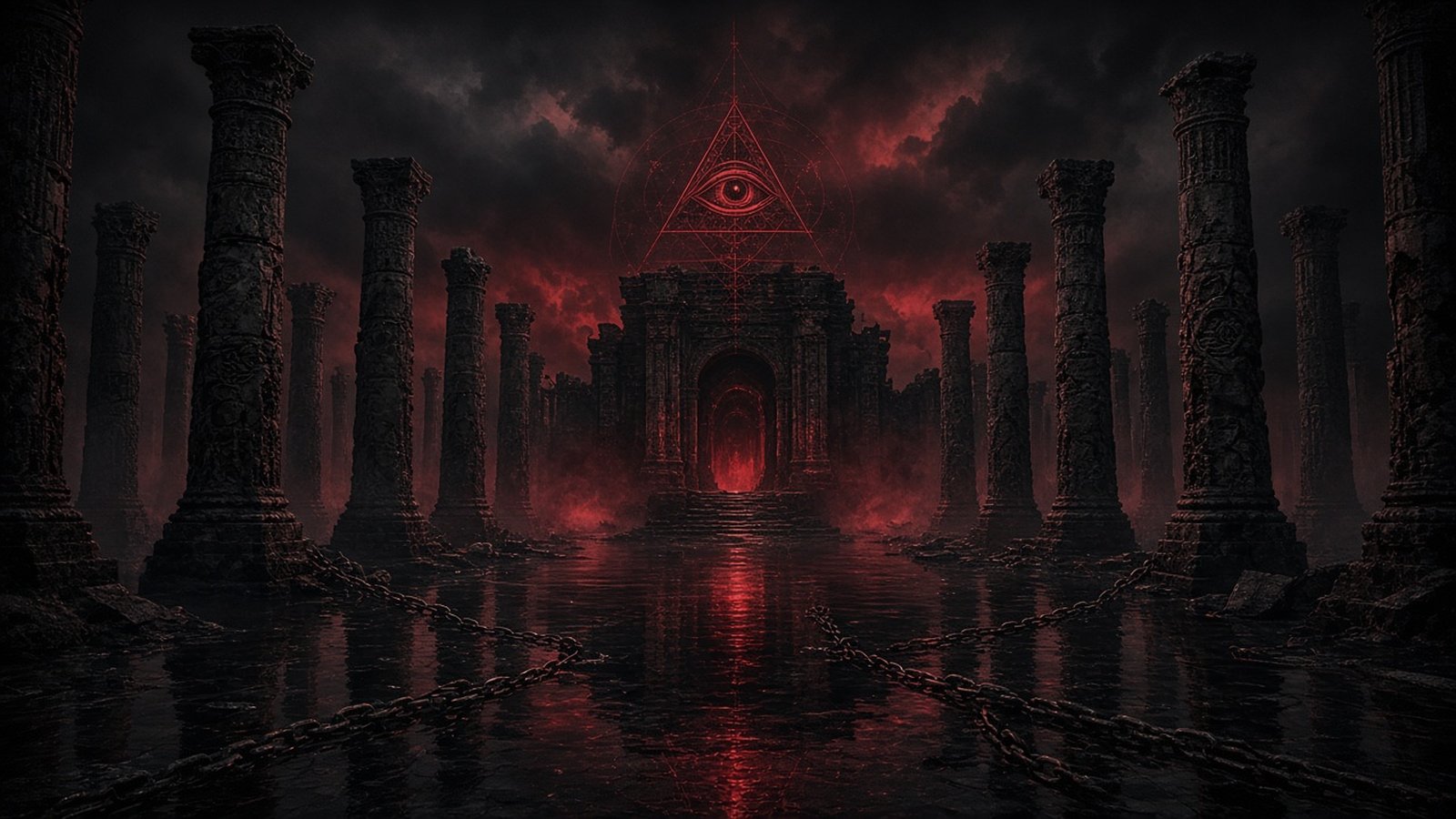
The western door opens onto a building that remembers everything brought inside. The Sound Kept by a Temple carries the wreckage of the Crossroads towards twin pillars, an unclosing eye and a geometry of stone and debt. The narrator searches for a lost word but encounters the sound he cannot forget. The unfinished structure has become a witness that offers no easy absolution.
The lyric's Temple is still empty enough to feel like enclosure. Walls close as judgment; silence becomes the material around the person trying to speak. Within Welcome to Anhedonia, this is an ending that keeps the earlier architecture audible rather than claiming it has already become refuge. It must not be confused with the later song The Temple, where the purpose of the walls begins to change. Here, the sound remains held in stone. The need to build differently is still something the wider journey has to face.