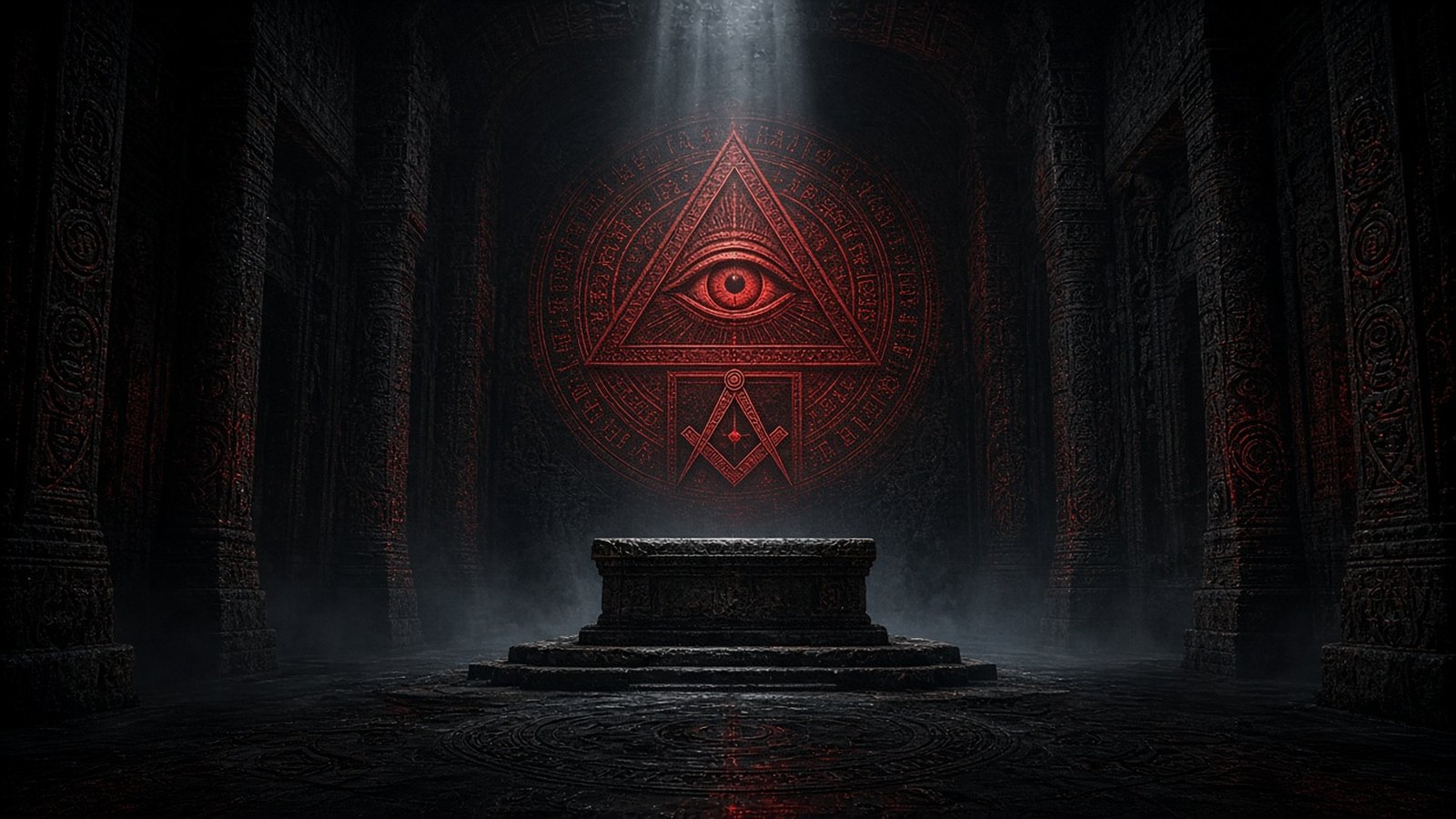
The destination
The Temple
Album · Full tracks
Full tracks
The Temple6:50
Meaning
It starts back at the crossroads, two roads under a blood red sky, one leading into darkness and one leading inside, and the first confession is that he thought he knew the difference. What follows is the building. He fills every room with enough noise that the silence can't speak, lays another stone over whatever he can't face, and gives his ghosts a place to stay. He frames his wounds and calls them home. The walls go up against the world, and then he wonders why nobody can reach him: he has built a place nothing could destroy, and nothing living can come near it. The halls are full of faces, some he remembers and some he used to be, names buried in the plaster and old promises under the floor, and every time he tries to leave, there's another locked door. Then someone arrives. Not a warning and not a plea, just a stranger at the entrance carrying the same weight he couldn't see, who doesn't ask for salvation, only somewhere safe. For the first time in his life the walls become a choice. Pain is not a promise, and grief is not a chain. Stones can't make a man whole, so he leaves the door open and lets the cracks stay where they are. Nobody has to call it healed, make it beautiful or call it strength. They can set it down and stay until the silence softens. The walls can hold the weight, the door stays open, and the work goes on.
The People's Temple7:49
Meaning
The second room turns the building outward. It opens on a question that belongs to anyone who has kept watch alone: who keeps the vigil when the keepers are lost, and who counts what it cost? He lays his bones between the stones, gives the voices somewhere to mourn, and follows the scar back to its buried source, only to find an altar he built out of loss, where the price was his. The chorus is an invitation rather than a sermon. Lay your ghosts on this altar and let the weight fall from your bones; the broken need no halo, and the damned don't need a tomb. Then comes the turn that gives the song its name. He hands over the tools. He built these walls from what destroyed him, but nobody else was born to build that way, so take the tools, rebuild your own temple and make a kingdom of your own. The verses carry the empathy that earned that offer: the hurt he can hear underneath someone's wrath, the hand he keeps extended where another would pull back, and a penance that means giving the voiceless their words back. He can't promise anyone peace. He can only build, stand beside the doorway, and tell them what's inside. He refuses to call the stone sacred just because it carries his blood.
Where The Threshold Bleeds7:33
Meaning
The third room is the entrance, still cut open. He built it from the words he had swallowed so the voiceless would not have to cross alone, and if the walls were raised from sorrow, the cut stays open for more than him. Come cross where the threshold bleeds. The cut will not ask if you are healed, only whether you can set the weight down. Some lay it at the first stone and walk through; some stand and measure if the blood is real. Those who cross do not look back at the man holding the wound. This is not the altar. This is only the line. The door does not close. He remains on it, still open.
The Weight Of The Temple7:14
Meaning
This is the song for the person who has been asked "are you all right?" so many times that the lie became their name. He knows that look because he's worn it home. He has answered every question without saying anything true, kept showing up for everyone while quietly disappearing, made the joke, changed the subject, and made the unbearable sound fine. But the body keeps the record. A thousand words, and not one he can let go of. The fury in the middle of the song is what that silence sounds like when it finally breaks. Then it softens into the confession at the heart of the whole album: he didn't find his peace in heaven, he found it where the words went to die. Some promises become the rope beneath you, and some debts survive the price you've paid, so he turned what he couldn't say into something you could hear. Now a stranger screams his buried words back at him, and for a moment he isn't alone. He still doesn't know how to ask for help himself. That's the truth, and the song doesn't pretend otherwise. What it offers is a room where you don't have to smile and you don't have to say you're all right. He can't promise the rain will end, but if his voice can reach you, you don't have to face it without a friend.
The Ritual Of Suffering7:14
Meaning
The closing ritual goes back to the crossroads, to the mouth of the world and the teeth of the flame, and counts the price of the oath. He asked for the tongues of the buried and unheard, and the price was the man who spoke for them. He judged his worth by the weight he could bear, and they called it devotion when there was nothing left. He carved himself hollow to give everyone else a home. Then the old road of ruin brings him back where it began, with no witnesses, no choir and no one left to convince, only the crossroads and the man he was expected to become. This time he answers. He will walk with the lost through the dark he knows, but he won't make a religion of sorrow. No wound is a crown, and no chain is a creed. Suffering isn't what makes something sacred, and he won't let anyone call his destruction devotion. The crossroads remain, the oath still has its cost, and he'll carry the name. But the wound is not worship, and the voice he gave to others has finally reached him. It closes on the work that isn't finished, still building the temple.
The Temple
The need for shelter is not proof that shelter has been finished. The Temple begins with the acknowledgement that somewhere must be made to hold the weight. Not a monument declaring the darkness conquered. Not a sanctuary presented as complete. A place still being built by a person learning what his walls have been for, and what they might need to become.
"The Temple is the final destination, but it's still being built. It's the acknowledgement that I have to build a place to hold the weight."
Those words hold the new album at the necessary point of honesty. Everything that precedes it has supplied material: the Crossroads, the Oath, the besieged mind, bondage, fracture, discipline, integration and the possibility of release. But material is not yet purpose. Stone can make a room or a cell. What survives can become an altar that keeps the wound in command, or a foundation from which another way of living begins.
The opening track, The Temple, exposes that contradiction directly. The narrator has laid loss into the walls, given his ghosts somewhere to stay and raised a structure no one can reach. Nothing living can come near the safety he thought he was building. The turning point is human rather than monumental: someone arrives carrying an unseen weight and asks, not for salvation, but for somewhere safe. The walls become a choice. The door does not have to remain barred.
That is the album's distinct work within the wider story. The World closes the Tarot cycle; The Temple does not reopen that cycle as though integration had failed. It takes the next difficult question seriously. What can the person build from what he understands now? A knowledge of suffering is not a command to keep worshipping it. A refuge that requires the wounded to hide has not yet understood what refuge means.
This chapter keeps attention on the building, its entrance, its burden and the work around it, without claiming all their stones are already laid. There is still weight at the entrance. There is still work beneath the name. Nothing about the need for a place makes the place complete.
The Temple therefore reaches towards belonging without selling a cure. Nobody has to make pain beautiful or turn it into strength before there is room for it. A crack can remain visible. A story can continue. A door can be left open while the builder is still learning how to build. The walls are needed because the weight is real, and the work goes on because the people carrying it are alive.
Refuge. Reflection. Transformation. Rebuilding. Purpose.
The place where the entire journey comes together.
It is unfinished because the story is still being written.
- Where it fits
- The destination. The heart of LOSTAT66.
- Why it comes here
- It is constructed from everything that came before. Pain. Mistakes. Loss. Shame. Survival. Discipline. Faith. Rebuilding. Purpose.
- Where it leads
- The Temple is the final destination, but it's still being built. It's the acknowledgement that I have to build a place to hold the weight.
This is what all of this was building toward.